
Bel Canto

Ann Patchett’s Bel Canto was a long-time TBR resident based on reviews I had read in book blogs, which means I added it sometime around 2014? 2015? and then finally read it in 2024. I would scroll past its cover now and again, debating if I was really still interested in reading it, but every time it made the cut.

Now I’m not sure if it was worth it.

An unnamed Latin American country invites a prominent Japanese businessman to celebrate his birthday and hopes, by feting him with a world-famous operatic soprano, to encourage his investment in the country. A guerilla paramilitary group breaks into the party, hoping to kidnap the president, and when they realize he’s not there, they take the entire birthday party hostage instead. The hostage situation drags on for something like four and half months, until it’s brought to an abrupt and tragic end. Minor spoilers undoubtedly follow, but I’m deliberately avoiding what I consider the real showstoppers.

Bel Canto was already going in at a disadvantage because I read it as an ebook. I’m not trying to be a print purist; in fact I’m grateful for the many advantages of ebooks! I can bring a near-infinite library with me in my pocket when I travel (or end up unexpectedly hospitalized), I can continue to patronize my US library from overseas, I can keep up with time-sensitive publications without running out of shelf space. However, I also know that my focus can suffer with ebooks, especially with Patchett’s style of writing: slow, reflective, internalized. Format was undoubtedly a contributing factor to my overall negative experience of the book. But even if I had read the book in print, there were several authorial decisions that would have still broken immersion for me.

The biggest unforced error out of all of these was conflating translators with interpreters for the entire book. (Translators work with the written word, interpreters work with the spoken word.) One of the main characters is Gen, an interpreter for the Japanese guest of honor who ends up interpreting for the entire collection of hostages and guerillas thanks to his facility with some half a dozen languages: Japanese, English, French, Spanish, Russian, German, maybe others. I realize that people often use the words “interpreter” and “translator” interchangeably (or rather, just use “translator” for everything), and from any of the other characters this usage wouldn’t have bothered me at all. But any interpreter I’ve ever known has always made a point of 1) thinking of themselves as an interpreter privately as a matter of vocational identity, 2) calling themselves an interpreter when discussing themselves and their career with others, and 3) correcting people who call them translators. Spending a whole novel with an interpreter who thinks of himself as a translator, and calls himself a translator, and sees absolutely nothing wrong with being referred to as a translator, broke immersion for me.

A couple of smaller, fuzzier details that rang weird for me had to do with the Swedish accompanist. His death from diabetic coma checks out (source: my Type 1 diabetic brother), but his name—Christopf—is well weird. Of course, since the hostage situation was based on the Japanese embassy hostage crisis in Peru and the soprano was based on Karol Bennett, for all I know Christopf is also based on someone else Patchett knew in real life and I will put my foot in my mouth by criticizing his name as unrealistic. I’ll just point out that there are zero hits for “Christopf” on either Hitta.se or Ratsit.se, which goes to show how widespread the name is in Sweden. There was also an offhand description of Swedish that initially struck me as odd, but upon rereading I’m willing to retract the criticism.*

That said!

It did make me more critically reflect on how Patchett describes the other languages in the book and there is a dodgy, hand-wavy ambiguity about how they’re described—even from the perspective of Gen, the gifted interpreter—that lacks the specificity of someone who feels comfortable speaking them. It’s unfortunate that this hand-waving is set up against the clear familiarity that Patchett has with opera. And if Patchett is comfortably fluent in any of those languages, then it’s even more unfortunate because she comes off as the exact opposite.

Speaking of the opera, it’s time to bring up one of my least favorite tropes: the healing power of music.

It’s maybe surprising that I would be annoyed by this trope since I’m a music person (see: the violin feels from Light From Uncommon Stars), but I would argue that it’s actually not at all surprising. It is the direct opposite of my lived experience that most people have the breathless, awestruck response to classical music that the characters in Bel Canto have. Of course there are opera lovers present at the party, and of course they love Coss’s voice, but Patchett imbues this soprano with an unearthly quality that entrances everyone present, including the guerillas holding them captive.

Or maybe I just have alto (contralto? tenor? my vocal range is sad) beef because sopranos already get all the love.

Anyway, I’d be willing to overlook those things but for one larger, underlying issue: MFA fiction.

A bookish friend and I have taken to using “MFA fiction” as a shorthand for a particular kind of overrated novel that I’m finding it difficult to describe now except: the purpose of MFA fiction is to show you, the reader, how enlightened the author is. Not just smart, necessarily. Not just educated. But also how emotionally transcendent they are. The narrative tone carries “a certain kind of false timidity” (to quote my friend), a self-conscious restraint and ironic distance. Outline is another great example of what we both consider MFA fiction. I think a lot of literary prizewinners are populated by this kind of writing because the judges like to think of themselves as equally enlightened beings.

Of course, I don’t have any specific illustrative quotes to present here, just “the vibe.” At this point I’ve totally failed at death of the author. Most of this review, most of my response to this book, is more or less based on what I assume Patchett’s motivations and background and intent to be, rather than the text on its own. The cool thing is that I’m just writing for this weirdo little blog and so it’s perfectly acceptable for me to fail at death of the author! Sorry Ann Patchett, you’re a more accomplished writer than I’ll ever be and I’m sure you’re a lovely person, but Bel Canto wasn’t doing it for me.

*Minus points for Gen learning Swedish from Bergman movies, though. It’s a cliche unworthy of what Patchett is attempting here.
Flame Wars: The Discourse of Cyberculture

If I wanted to depress myself, I would do a series called “In Search of Lost Bookstores” and feature books in my library that I purchased at stores that have since shuttered.

Just kidding, I’ve already depressed myself just by thinking about it!

One of those entries would be this thirty-year-old collection of academic writing on the nascent online culture of the early 90s. In high school, anything at all related to Cool Cyberpunk Hacker Shit was instantly my bag, so I picked up Flame Wars: The Discourse of Cyberculture on one of my many youthful browses of the Lion Around bookstore (RIP). It was already ten years out of date by that point, but no matter! I read a couple of the essays right off the bat; I gave most of the others a pass as uninteresting and highly technical. . Nonetheless I kept the volume through several purges, sensing that one day I would have enough of a brain to actually engage with the content. That day was today, the year of our Lord 2024, a full thirty years after its initial publication—an ice age ago in online time.

How does it hold up?

In some aspects not very well at all, or maybe more fairly: it’s clearly a book of its time. Lots of ink is spilled over Mondo 2000, reminding us that people once took it seriously as a cultural forum. (Though I guess its ghost still haunts the Internet in the form of BoingBoing.) When discussion focuses on the intersection of technology and sexuality, it’s as awkward and dated as you’d expect (did anyone ever actually call it “compu-sex”?) and HIV/AIDS as an existential threat is a very present issue. In much of the discussion, sexual and otherwise, the underlying assumption is that VR is going to be the thing pretty soon and that people will be using that to have safe, gratifying casual sex—but for now, typing will do. Thirty years later, it’s safe to say that VR didn’t pan out like any of these authors were expecting.

There are also selections that, even without the retro-futurism, kind of stumble. The performance art group Survival Research Laboratories is still running to this day (would you like to subscribe to their Patreon?), but the account Mark Pauline provides of a show in Austria fails to articulate anything interesting beyond the deathwish of one of their local assistants. (The numerous photos of the Austrian show/exhibition were black and white; maybe full color would have helped.) Another essay on virtual reality as a plot device in fiction feels like a puffed-up excuse for Marc Laidlaw to showcase his own writing. Halfway through the piece, Laidlaw confirms this suspicion and explains that he was originally asked to submit a selection of his fiction, but felt whatever he submitted would be out of context, so he wrote an essay about the topic of virtual reality and then included his own writing in the essay. The other piece of fiction, an excerpt from Pat Cadigan’s Synners, was simply presented on its own as a piece of fiction and functioned just fine without context. (And in fact, I promptly added the whole book to my TBR after I finished the chapter.)

The more abstract, theory-based, and otherwise philosophical essays, on the other hand, still feel highly relevant. Editor Mark Dery’s interviews with Samuel Delaney, Greg Tate, and Tricia Rose (collected in the chapter “Black to the Future“) are a goldmine of thought that I will definitely be revisiting, moreso because Dery chose to interview extremely intelligent people rather than because Dery provided much insight himself (sorry). Likewise with Claudia Springer’s “Sex, Memories, and Angry Women,” which touches on an interesting tension in the portrayal of women within cyberpunk but that also requires me to refresh my memory (hah) of the works in question before I can really have anything to say about it. I don’t know enough about the state of neural networks and AI research to know if Manuel De Landa’s “Virtual Environments and the Emergence of Synthetic Reason” is still fresh, but Gary Chapman’s* “Taming the Computer” still feels as relevant as it did in 1994. Perhaps—cliché be damned—even more so.

Cue the ominous music.

Overall, despite some dated, now-irrelevant concerns and speculations, a solid collection to have on hand in 2024.

*This is Gary Chapman the technologist and academic, who died in 2010. He’s not the Gary Chapman famous for the Five Love Languages, but sadly only the latter has a Wikipedia page.

Summer

I have a vague memory of being recommended Ali Smith’s Summer last year by a friend of a friend who teaches English at the university level, but my memory of his recommendation (“It’s like the book version of what we’re doing right now, people having conversations just like this”) so misaligns with what happens in the book that I wonder if I missed something. Or maybe Summer ended up on my TBR for other reasons and the English professor’s recommendation was something else entirely. I also learned, long after I finished it, that Summer is the last of a quartet and that several of the characters had appeared in the previous installments.

Basically, I came in to this book all wrong, so this is going to be an extremely…unfair? confused? unhelpful?…review for anyone who actually has the full context for the book. Sorry.

A pair of siblings—teenage environmental activist Sacha and her proto-edgelord younger brother Robert—end up befriending a pair of adults and, along with their mother, make a quick trip in a post-Brexit, mid-Covid England to return a lost/stolen item to its rightful owner. Based on what I’ve read in other reviews, most of what happens in Summer builds on stories and characters established in the previous three books and maybe? maybe not? ties up some loose ends.

Despite my clearly misguided expectations, I really liked Summer. Smith balances a relatively large cast of characters well, keeping their internal monologues consistent with how they’ve behaved from other character’s perspectives.

Mostly.

There is a missed opportunity with Sacha and Robert’s mother, the sole Leave voter in the group: when the book comes around to her perspective, Smith doesn’t really bother to speculate her motivations or feelings about Brexit and that feels like a cheap out. Its absence is made even more noticeable when you consider how much time we spend with Robert, who is currently acting out through extremely anti-social behavior.

On the whole, though, the different perspective characters feel distinct. Sometimes authors love the sound of their own voice a little too much and when they attempt an ensemble cast, characters lose all personality when it’s their turn to pilot the ship. Even if everyone has more or less similar politics (Brexit aside), Smith avoids that particular trap.

People who had read the previous three note in their reviews that Covid seems shoehorned in based on everything else, but I didn’t really walk away thinking “wow those lockdown bits were a bit tacked-on and weird,” so perhaps that’s an advantage of coming at the book from the completely wrong angle.

My only criticism, which is perhaps more of a reflection on me and the kind of person I am, is that I felt a bit manipulated by the inclusion of Vietnamese refugee Anh Kiệt. The parallels to the internment of “enemy aliens” in the UK during World War II are enlightening and fair to make, and I don’t begrudge Smith that point at all. However, Anh Kiệt himself gets pretty limited time in the story. Sacha writes to him twice throughout the book (and we see both pieces of correspondence) and we get to read his single reply to her, full of enthusiasm and optimism and hope, in the somewhat limited and uneven language you would expect from someone who acquired English informally and later in life. As far as character development goes, it’s not much, and it comes off as romanticized and idealized. His reply to Sacha is the last chapter of the book, which on the one hands lends it some gravitas, but that doesn’t make it any less flat. For comparison’s sake, the flashbacks to the World War II internments are longer (probably, though I didn’t go back and count up the pages, but they feel longer) and through the perspective of a character with fluent command of English, so his depiction is a bit more detailed and multifaceted. Never mind that this character apparently is the central figure in one of the previous books.

My initial reaction to finishing Summer, with Anh Kiệt’s optimism and nearly Pollyanna spirit, was to get a bit choked up at the goodness of the world and the undaunted spirit of hope etc. etc. Then I got annoyed at myself for getting choked up, because in a book full of research this is still fiction and who’s to say if Anh Kiệt ever existed. It’s the same “too good for this world” characterization of Ali from Där vinden vilar, but the book situates Ali so thoroughly in his community that it’s easy to read this idealized teenager as the hopes and desires of a family, of a village, of a country. Anh Kiệt doesn’t have much of a pre-refugee identity or status, so he feels like a narrative device cynically designed to elicit a reaction out of me, and I hate that in a book.

On the other hand, I read L’elegance du herisson and cried at the end all three times, so I like to think I’m not entirely heartless. What makes it effective there but cynical in Summer? I guess the answer is: the time I spent with the characters in question. We spend a lot of time with Renée in L’elegance du herisson since she’s one of the point of view characters. The same, even, with Ali in Där vinden vilar. But Anh Kiệt only gets his single chapter at the very end.

Or maybe the problem is me.

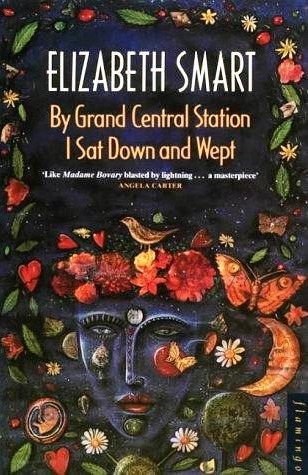
By Grand Central Station I Sat Down and Wept

Following hot on the heels of Mumbo Jumbo, the next entry on the list of “books I feel like should have been on my literary curriculum but never were” is By Grand Central Station I Sat Down and Wept, Elizabeth Smart’s intense…novella? multi-part prose poem?…regarding her long-term affair with poet George Barker. Did I know that when I grabbed it at random off the library shelf? Absolutely not. Did I think for a minute that the Elizabeth Smart of my own growing-up had written a novel with a title off a prog rock album? Shamefully, yes, but I was disabused of this notion as soon as I read the back of the book. Considering its light weight and my impending vacation, I figured this was a good contender for a back up English book to have with me and checked it out alongside Ali Smith’s Summer.

The comparison that immediately springs to mind is Requiem över en förlorad stad and Cold Nights of Childhood. We have a nameless woman wandering through the locations of her own memories, though the narrator seems more chronologically bound in Grand Central Station than in either of the other two. While highly surreal throughout, you can still trace a narrative thread that begins with meeting Barker in person, continues through the consummated affair and subsequent periods of separation until it ends sometime after the birth of the narrator’s child, all of which is rendered in evocative and startling metaphor. This will undoubtedly be a re-read for me at some point in the near future, though with my own copy that I can safely mark up and read at my leisure.

Mumbo Jumbo

Ishmael Reed managed to escape my attention until someone mentioned his play The Haunting of Lin-Manuel Miranda in a podcast I was listening to. In lieu of being able to see it staged (I guess I could still read it…), I added his novel Mumbo Jumbo to my TBR. However many years later, I found a copy of it at a bookstore in Chicago. (Not the same one where I found Refuse to Be Done, for anyone keeping track at home.)

The Knights Templar, along with the fictional Wallflower Order, are at work during the 1920s to stop a virus called “Jes Grew,” originating in Black culture and music, that leads to a sense of euphoria uncontrollable dancing. Working against them is PaPa LaBas, a Vodou priest on the trail of a MacGuffin that, united with the virus, will bring an unprecedented new age of freedom and human expression. The Knights, of course, want this MacGuffin destroyed. In the end LaBas is unsuccessful, but fifty years later LaBas is confident that a new opportunity to bring Jes Grew and another iteration of the MacGuffin together is waiting just around the corner, noting that several cultural trends of the 70s are identical or similar to the ones that gave rise to the virus in the 20s.

That summary does a huge disservice to the book, though, since all of that plot is really there as a vehicle for satire and social commentary. It reads a lot like the Illuminatus! trilogy, or what I remember of it anyway, except I never felt like Illuminatus! should have been part of my literary education. In that sense, Mumbo Jumbo has more meat on its bones. It’s another title for my list of “books that I am surprised (not really) were never assigned reading,” which started with No-No Boy in 2017.

Refuse to Be Done: How to Write and Rewrite a Novel in Three Drafts

Honestly, I wasn’t super enthused going into this one. Matt Bell’s Refuse to be Done was the first title from my TBR that I found at a bookstore in Chicago and that was enough for me to declare my errand done rather than force my hosts to languish in the bookstore longer than necessary. (Not that they would have called it languishing, but still.) I finished it on a bus between Albany and the Port Authority Bus Terminal.

This book just isn’t for me. Only a few of the tips or tricks in here are ones that I could apply to my own writing, and the promise of the title (“how to write and rewrite a novel in three drafts”) is 100% a bait and switch. If you follow Bell’s advice, you will definitely write more than three drafts, but “three drafts” is a much more enticing promise than “three stages.”

The three drafts promised in the title boil down to:

  1. What Bell calls the “exploratory draft,” or what I think of as “the NaNoWriMo draft.”
  2. The “rewrite, don’t revise” draft, whose goal and purpose seems a bit unclear and muddled. I think part of the reason the book has no table of contents is because it would become very clear how little meat and potatoes Bell has to offer for this section. (The chapter on the exploratory draft is close to 70 pages; this one is around 16 pages. The last chapter is around 50 pages.)  As far as I can tell, this is where he thinks you should carry out major structural and story revisions. But then he sums up his advice as:

When in doubt, rewrite instead of revise.

How do you know if you’re rewriting versus revising?

Some clues: the presence of new typing (or at least retyping) and the absence of merely copying and posting.

When in doubt, rewrite instead of revise.

Trust me.

And at first blush that seemed like the exact opposite of what he was trying to convey in this very brief chapter? “Just spit and polish that dreadful scene you have instead of fundamentally changing it.” After multiple re-reads and several days of reflection, I think what he means is something like: write over scenes from scratch instead of just trying to tweak what’s there. The problem is that “rewriting” and “revising” never get very clear definitions; it’s the equivalent of being told “cribble, don’t tralapse.” This chapter might as well be called “draw the rest of the fucking owl.”

3. The last stage, or draft, sounds like a “spit and polish” draft where the focus is on language rather than narrative, but again he doesn’t really give it a name or clear purpose so who knows.

In addition to the bait-and-switch title and the “draw the rest of the fucking owl” vagueness in the middle, like any book on writing there is the obligatory list of the author’s personal pet peeves presented as Objectively Bad Writing mixed in with helpful exercises. At least at this point in my life I know to just skim those sections rather than live or die by them.

To his credit, Bell cites a lot of interviews and articles from other authors describing their own process. He also gives a lot of concrete examples of well-done prose and unique narrative structures for curious readers to investigate, as well as in-depth reference books on more niche elements of style. As usual, finishing one non-fiction book on my TBR only led to me adding others.

Really, this would have been better as a library read than a purchase. The only reason I don’t regret plunking down money on this book is that it went to support a local indie bookstore. Refuse to Be Done might be the book that gets someone started on their very first novel, but I am not that person.

The Dawn of Everything

What a doorstopper!

The reason I meticulously note (almost)* everything I read here is so that I remember reading it. I don’t know enough about the brain to know if writing about things really helps it transfer over to long-term memory, but I’ve already had the experience of completely forgetting something I said or did until I re-read a journal entry about it, so I assume the same holds true for books.

All of that to say, I don’t think I’m capable of doing The Dawn of Everything justice here. In a nutshell, David Graeber and David Wengrow look at archeological and anthropological evidence to (in their own words) “ask better questions.” The paradigm that they’re trying to upend is actually quite similar to the one that Stephen Jay Gould also sought to demolish in Full House:

The argument Gould makes in Full House is basically one against the teleological framework of evolution: that things evolve for some higher purpose, or more specifically deliberately towards complexity; that complexity is somehow the best, most special, or most desirable form of life.

(quoting my own summary there)

But instead of deconstructing a teleology with complexity as the end goal, here Graeber and Wengrow are deconstructing a teleology with agriculture and the state as an end goal; that agricultural was an instant revolution that inevitably led to an apparatus we currently call “the state,” and that the world we are living in now is more or less the inevitable end state of things. They also occasionally take the time to dunk on Yuval Noah Harari’s Sapiens and Jared Diamond’s Guns, Germs and Steel.

The whole book is something like 400, 500 pages to argue against this conclusion, and frankly I don’t have the recall or the comprehension to reconstruct it here. Like David Graeber’s Debt, I’ll have to read this one multiple times to really be able to confidently explain its premise. What I can say after one read-through is that they believe the archeological evidence points towards a history of mankind that experimented with flexible and novel arrangements of power that, even on a large scale, preserved what they call the three basic freedoms: the freedom to make promises, the freedom to disobey orders, and freedom of movement (the freedom to leave a place if the situation becomes too onerous).

There’s a lot of non-fiction that I read because I have weird niche interests, or because I ran across it at the library and it seemed interesting. There’s also non-fiction that I tackle because I want to better understand the world I live in, and The Dawn of Everything falls squarely in that category. More than that, there’s a category of non-fiction that I wish were required reading so we could start building consensus reality again and so we could maybe learn something from history. The Dawn of Everything is one of those books.

*Some are so niche and special interest that I don’t really see the point in including them here in my public record of reading. My commonplace book, as it were.

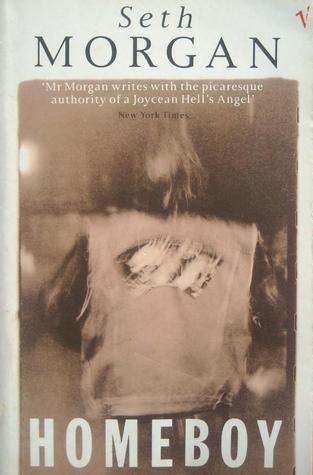
Homeboy

I summarized my “acute TBR” a few weeks ago thusly:

the English translation of Frère d’âme, Homeboy (borrowed from a bookish friend), Händelsehorisonten and Singulariteten (ahead of another bookish acquaintance’s panel moderation with author Balsam Karam in May), and a pair of niche but mercifully brief Swedish reference books before a test in October (and ideally before a third English reference book arrives sometime next month).

Since then I have finished Frère d’âmeone of those Swedish reference books, and that third English reference book. And now Seth Morgan’s Homeboy! Will I wrap up the acute TBR before my trip to the US rolls around in May? Who knows!

This particular entry on the acute TBR was more acute than I realized at the time. By the time this post goes up, the book’s owner will be en route back to the UK, unlikely to return to Sweden again. I could have returned it to him unfinished, of course, and eventually procured my own copy. Or I could have held on to it and returned it on a future visit—a bold move on my part, but I know I would have followed through. Nothing wrong with either of those!

But Homeboy wasn’t just any recommendation—it was one that came up in a conversation about what I term “bagel books,” books that you like so much you simultaneously want to tear through them as quickly as possible and never want to keep reading because you don’t want them to be over. A bagel book is a very particular, almost hallowed kind of recommendation. Being able to spend a friend’s farewell party talking to him about one of his own bagel books was therefore an appropriate and meaningful send-off.

Personal circumstances aside, Homeboy is also an interesting work from a historical? biographical? perspective, the only novel from the man who was Janis Joplin’s fiancé at the time of her death. That’s the other reason I was keen to get into the book, even though by all accounts Morgan and Joplin had a really dysfunctional relationship. You could make an argument that Morgan was a contributing factor in her overdose, even, but that’s neither here nor there. This isn’t about my weirdly in-depth knowledge of Janis Joplin’s biography, it’s a book review!

In my farewell party extemporaneous analysis, I described Homeboy as a mash-up of Elmore Leonard and Jack Kerouac, though my friend didn’t entirely agree, so take that with a grain of salt. The plot centers around the theft of a rare diamond, the Blue Jager Moon, from pimp Baby Jewels Moses by protagonist Joe Speaker, and everyone’s subsequent attempts to recover it. Joe wants to eventually move it and get clean; Moses wants it for blackmail material over a judge on the California State Supreme Court; Officer Tarzon needs it as evidence to put Moses away and complete his own private revenge.

There’s a lot more than that going on, but reading it in summary isn’t the same thing as reading the book itself. Homeboy has an ensemble cast of street life characters who all have assorted arcs, rises and downfalls interwoven with the main Blue Jager Moon narrative. Morgan also has a knack for the right kind of details that make even one-off side characters instantly distinctive, like dealer Rigo La Barba:

Rigo La Barba slumped on the nod in the crushedvelvet front seat of his ’62 Impala lowrider at the corner of Sixth and Mission. He was called La Barba, the Beard, after his carefully groomed goatee.

Next to the highgrade chiva he dealt, La Barba was proudest of  his lowrider. It had jeweled vanity mirrors attached to the sun visors, a miniature crystal chandelier in place of the dome light, a goldplated chain steering wheel, and, next to the ivory Virgin atop the minklined dash, a keyboard on which he could play “Besame Mucho,” “Don’t Cry for Me Argentina” or, more to the point, “Chinga Tu Madre,” according to his cholofied caprice. Over twentyeight handrubbed coats of topaxflake lacquer, sequined rococo script announced La Barba’s philosophy on one rear fender: Low ‘n’ Slow; and on the other he christened his chrome galleon Crystal Blue Persuasion.

Joe hits up La Barba once for some heroin and that’s it. We never meet La Barba again.

The whole thing is great fun and imbued with a surprising amount of pathos; I’m honestly surprised it hasn’t been turned into a movie yet, given the break-neck pace and the visuals, both comic and gory. Speaking of which, there is a fair amount of casual gore, and in fact a fare amount of casual just-about-everything. A good chunk of the story is set in prison, and when we’re not in prison we’re following the progress of pimps, hired goons, or sex workers, so it’s a lot. The two things worth mentioning are:

  1. Someone could probably write an essay on Baby Jewels Moses and anti-Semitic tropes. Is it so cartoonish and over the top that it circles back to become lampshade and subversion? Is it just Problematic? I’m not equipped to answer these questions.
  2. Someone could a probably write another essay on gender and sexuality in prison culture as depicted in Homeboy. The “queens” in the prison are central characters to some of the later events and fellow prisoners are mostly untroubled by their gender presentation. The AIDS epidemic also looms large in portions of the novel, with sympathetic rather than terrified undertones.

A fun, meaty book. A bagel book, even.

Delayed Gratification No. 52

One of the reasons that my book reading is taking a temporary dip is because I had some magazines to catch up on. Since I think those are just as important as books—and just as prone to otherwise getting lost in the void—I decided it was worth summarizing them. For posterity’s sake, and also to help me retain what I read.

Background: Delayed Gratification is a UK publication put out by an organization called Slow Journalism. It was recommended to me after I mourned the loss of the English language arm of the incomparable De Correspondent, a news project that is unavailable to me because I don’t read Dutch. De Correspondent features long-form stories focused on underlying causes or trends rather than rapid-fire news updates, and after a successful launch in the Netherlands they expanded into the English-language market as The Correspondent in 2019. Things went well until the economic fallout from the pandemic kneecapped their “pay what you want” subscription model, and rather than selling adspace or short shrifting the writers and graphic designers, they closed the project down. All of the English-language stories they published are still available on their website if you’re curious.

Enter Delayed Gratification! It scratches a similar itch and carries a mix of longer form journalism and shorter interviews/explainers (called “Moments that mattered”), along with more infographics than I really would care to read. Nobody’s perfect!

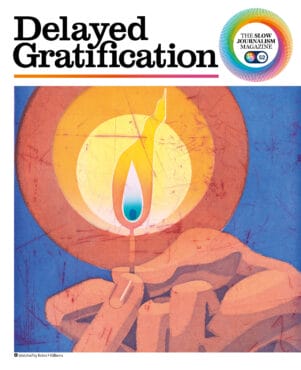
Every issue features a different artist on the cover, and opens with an interview as well as some of their other work. This quarter it was Robin F. Williams, with “Matched.” None of her other pieces are really a….match…for the painting featured on the cover (pictured above), nor was hers the most interesting or insightful artist interview I’ve read:

Starting a fire with a match requires precision, care and timing. It’s an individual action with the potential for a profound impact.

“Skill issue” was a friend’s glib response to that quote. “Grant for writers to take a wilderness basics course…”

Longer pieces

1. “Nahel Merzouk is buried amid riots in France.” The article by Rob Orchard highlights the work of French journalist Valentin Gendrot, who went undercover as a cop and wrote about it in the book Flic. French cops seem to resemble their American counterparts, is my takeaway, though perhaps they aren’t quite so heavily militarized (yet). Flic also ended up on my TBR: a French language and non-fiction two-fer!

2. “The coming storm.” Joint reporting by Matthew Lee and Rob Orchard on the bankruptcy crisis for many UK councils, whether current or looming. In some cases, poor decisions were made (going all-in on commercial real estate investment in the name of “development”). In others it’s just bad luck—shifting demographics is one reason highlighted in the article, where national funds are allocated to councils at the local level based on population data that is wildly out of date. Upon reflection, maybe that’s less bad luck and more “this is what happens when you kneecap actually-useful parts of bureaucracy.” Some areas are full to bursting with families with young children, for example, but not seeing the national funding to provide schoolingfor them because demographics statistics at the national level haven’t been updated.

3. “Metropolis now.” Marcus Webb, with photos by Nick Hannes. Projects to move national capitals: Egypt, South Korea, Nigeria, Kazakhstan. The people designing and paying for these new cities all gush about Dubai,  striving to emulate it in their city planning. This story, in combination with the previous article about bankrupt councils and a later one in this issue about rich people who want to live forever, is rich grist for the dystopian science fiction mill: wealthy, powerful people trying to build self-sustaining isolated little enclaves for themselves, away from unwashed masses, for all eternity.

4. “What lies beneath.” James Montague. Last July the loading ramp from the MS Estonia was pulled out of the Baltic, sparking renewed interest in assorted Scandinavian and Baltic conspiracy theories about why the cruise ship really sank. I didn’t know much about the topic going in, since it’s never come up in my life here—just that the MS Estonia had been a cruise ship that sank with absolutely catastrophic fatalities, and that there are a whole raft (if you’ll pardon the pun) of conspiracy theories about it. Montague interviewed several people with different relationships to the disaster: a Swedish survivor, a former Swedish politician from the Green party who remains convinced that Russian espionage was involved, the Estonian son of a couple who were lost in the sinking, and another young Estonian guy who was so fascinated with the sinking he grew up to become an expert in analyzing shipwrecks.

5. “Who wants to live forever?” Matthew Lee. This one touched a nerve with me. I can’t find the topic of “eccentric billionaires who want to live forever” interesting or entertaining—all I can think about is the tremendous exploitation and waste of resources involved. It also seemed clear that Lee doesn’t have the requisite background in science to really contextualize “longevity research.” (I’m directly quoting their language but I’m also making the scare quotes gesture with my fingers.) The project is painted in a mostly optimistic, friendly light and most of the people Lee interviews are of basically the same opinion. This is in contrast to the article on the MS Estonia, where Montague included a variety of perspectives that kept the speculation distinct from what could be asserted based on facts and data. To Lee’s credit, he also made sure to speak with a noted critic of the movement along with its cheerleaders, but the bulk of the article is concerned with the longevity research’s possibilities and proponents.

The last thing worth mentioning about this one is that one of the longevity companies Lee discusses is The Methuselah Foundation, and he makes a point of drawing the explicit (inoffensive and even vaguely favorable) connection between the foundation and its star backer, Peter Thiel. Yet nowhere does Lee see fit to mention this interest—not only longevity research generally, but Thiel’s participation specifically—has become one of the richest veins for Qanon conspiracy theorists to tap: tall tales about wealthy elites preying on children in pursuit of eternal youth, Thiel shooting up adrenochrome, God knows what else. Nor does Lee mention Thiel’s more unsavory, anti-democratic activities, which include limiting journalistic freedom as best he can. Is that relevant for a journalist to bring up in an article about longevity research? Do I just have a particularly strong personal antipathy towards Peter Thiel? Maybe it can be both?

6. “A wolf at the door.” Harriet Salem. The reintroduction of wolves to Europe is tricky going. Most frustrating seems to be that the European Commission president, Ursula von der Leyen, could just unilaterally decide to undo years of wildlife preservation work by greenlighting wolf culls.

In absolutely, definitely, for sure unrelated news, der Leyen’s prize pony was killed by a wolf a few years ago.

The thing I noticed in this article was how many of the concerned farmers who want to bring back wolf culls are self-described “hobby farmers.” It reminds me a bit of Marie Antoinette pretending to be a milkmaid at Versailles, though to be fair, maybe hobby farming is how we slowly start to decentralize food supplies so that we have more food ready at hand. (But then maybe it’s more practical to grow grains, fruits, and vegetables than to raise livestock? In which case wolves are irrelevant?) Plus, left to their own devices with a normal mix of population, cattle (and I assume sheep) are a pack animal that have interesting strategies for surviving attacks from predators. There’s really interesting material about how cattle fared after wolves were reintroduced to Yellowstone, which I don’t have the time to look up right now. Not to mention that, as Salem also points out, domestic dogs are more of a threat to livestock than wild wolves.

7. “Derna is a city drowning in sorrow.” Interview by Marcus Webb with photographer Mohamed Nabil, Zainab Chamoun interpreting. An on-the-ground look at the flooding in Libya. Hopefully they’ll put at least the photos from this story up and I can come back and link to them because I think it’s difficult to understand the scope of this flooding—especially considering other huge geopolitical crises going on at the moment—without seeing pictures of the damage.

Moments that mattered

1. “Lahaina is destroyed by wildfires.” Interview with Crystal Mitchell, Lahaina resident and business owner, by Matthew Lee. It seems that incompetence was a huge contributing factor into the fires becoming as bad as they were, as well as the scope of the damage. Unlike previous wildfires, the Mitchells (and many others) received no warning to evacuate and had no time to prepare. The escaped with their lives, but they lost two pets in the fire and Mitchell’s husband suffered pretty serious burns. Lots of events in the last few years, including the Lahaina fires, have me thinking about the inherent fragility of tourism-based economies.

2. “Luis Rubiales forces a kiss on Jenni Hermoso.” Interview with Verónica Boquete, former Spain women’s national football team captain, by Harriet Salem. A short summary of the state of misogyny in women’s football in Spain. Spoiler: it’s pretty awful.

3. “Azerbaijan takes control of Nagorno-Karabakh.” Interview with Laurence Broers, co-founder of the Caucasus Survey, by James Montague. Speaking of stories that get swallowed in huge geopolitical crises, how about this one? I had a vague sense of violence in Azerbaijan at some point recently but that was about it. This wasn’t a huge in-depth explainer of the history of the relationship between Azerbaijan and Armenia, but still informative. The major takeaway from me was how much Turkey’s support made a difference, especially as Russia’s presence in the region is basically nothing now that they’re caught in the quagmire of Ukraine.

Other

1. “Saddam and the supergun.” Marcus Webb with art by Carol Adlam. A sort of graphic novel visual narrative of the life of Gerald Bull. All the conspiracy theory talk with the MS Estonia and Qanon when there’s much more fertile (and likely) ground right here, with briefcases full of cash and assassinations and everything!

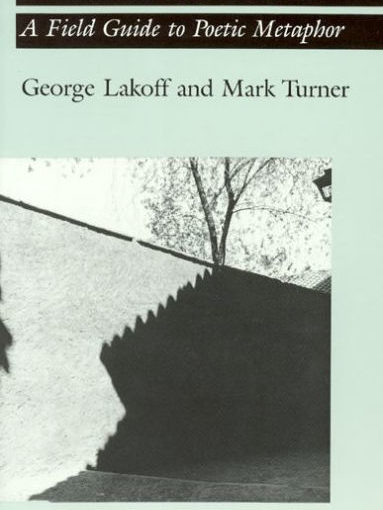
More Than Cool Reason: A Field Guide to Poetic Metaphor

While I was on my last library errand of 2023, I happened upon this one in the shelf alongside Språkets myller. Since I’m an incurable fan of George Lakoff and his work on metaphor I figured “why not?” and threw it on the pile. I finally finished it last week and here’s to hoping this will uncork the backlog of reading I have for the year. I accept my long-term 600+ book TBR as something like a calculus limit, to be approached but never quite reached, but the acute TBR has hit critical mass where I now have an inner urgency to do something. The current acute TBR: the English translation of Frère d’âme, Homeboy (borrowed from a bookish friend), Händelsehorisonten and Singulariteten (ahead of another bookish acquaintance’s panel moderation with author Balsam Karam in May), and a pair of niche but mercifully brief Swedish reference books before a test in October (and ideally before a third English reference book arrives sometime next month). Until last Friday, More Than Cool Reason was also on the list. One down, five to go.

More Than Cool Reason is a much briefer work than the highly specialized Philosophy in the Flesh (what book isn’t briefer than that one) and also slightly shorter than the general interest Metaphors We Live By. This time Lakoff and cowriter Turner…turn…their attention to metaphor as it is deployed in poetry. Here their stated audience is undergrad-level literature students, so the book functions as an introduction to Lakoff’s theory of metaphor, with poetry specifically as a test case. They begin by dissecting a few short poems (or selections from longer ones), mixing familiar classics like Shakespeare sonnets and Dickinson with some translations from outside the classic English language canon, and note how the conventional metaphors we have for understanding everyday concepts make for effective poetry (“People are plants,” “Death is a journey,” “A lifetime is a day,” “A lifetime is a year,” etc.). There’s also discussion of what makes metaphors effective versus nonsense and some philosophical discussion of Lakoff’s theory, criticisms of it, and Lakoff’s response to the criticism. The book ends with a close reading of William Carlos’ Williams “To A Solitary Disciple” as well as some Chinese proverbs.

The other reason I picked up More Than Cool Reason was because I don’t get poetry. At the end of the day I’m just too literal minded to really be receptive to most of it, I think, so I thought that this kind of nuts and bolts approach to poetry would help me be a better reader. Did it? Unsure. I don’t know that I’m a better reader of poetry now, having finished the book—I would have to go out and actually read poetry with this insight fresh in my brain—but the approach Lakoff and Turner take in this kind of literary analysis is so thoroughly grounded in the text and in the concrete that I at least feel like I’m a better reader of the poems they dissected in the book.

I would rank Metaphors We Live By as the better general interest introduction to the topic. Not everyone is interested in becoming a more informed reader of poetry, but I think most of us are vaguely interested in becoming better communicators and in better understanding how other people think. I also wish that More Than Cool Reason had been course literature for my poetry class in undergrad (no shade on Fussell’s Poetic Meter and Poetic Form). For all I know, it would have helped demystify poetry for me twenty years earlier.