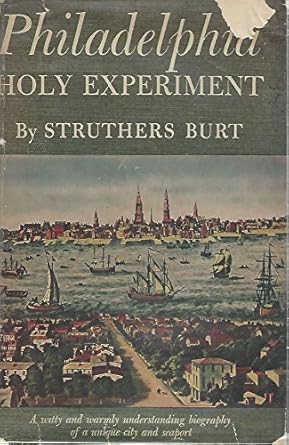
I rescued this battered old Maxwell Struthers Burt hardback from the collection of books that my dad seemed to have inherited from his own father. I suppose something about moving across an ocean makes you sentimental for the place of your birth, especially since I’m forever explaining to people that I’m from “north of Philly.”
I had a grand time reading it. The footnotes and commentary alone are pure entertainment, if not necessarily the strictest history. Published in 1945, the most important niche that Philadelphia: Holy Experiment fills is as a World War II era time capsule. How were Americans thinking about themselves and their history while they were fighting Nazis abroad? Also, it includes a recipe for Fish House Punch in the endnotes. Amazing.
Sometimes I wonder if specific book friends should get their own tag, for my own ease of reference if nothing else. So much of my reading can be traced back to recommendations and influences from people I like!
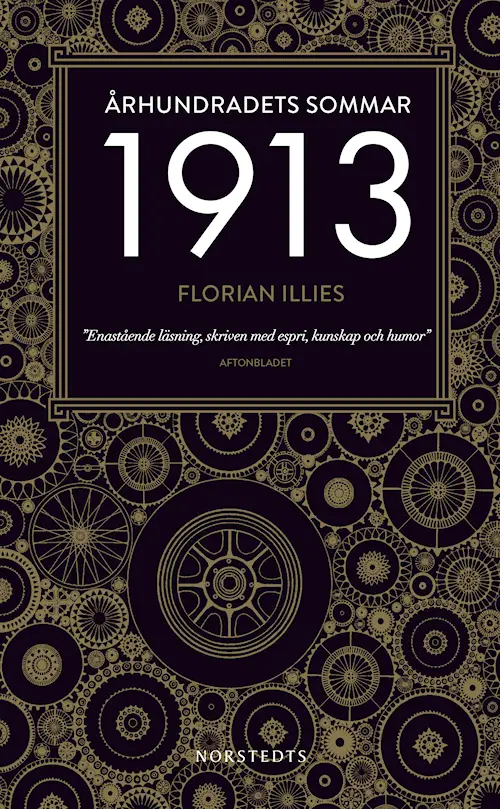
1913: Århundradets sommar, originally published in German as 1913: Der Sommer des Jahrhunderts and known in English as 1913: The Year Before the Storm, is simply the account of a single year in Europe from the perspective of numerous writers and artists (as well as a couple notable politicians). The same book friend for whose sake I made a third and final attempt to read To the Lighthouse and to whom I had gifted The Heart is a Lonely Hunter, who lives next door to the author of Årsboken and who had also recommended Njals Saga, pressed a slightly beat-up paperback copy of 1913 into my hands back in January or February. I started immediately, stopped when I realized I simply had too much else going on at the time (trying to get through Svälten and Kusinerna for assorted book clubs on top of Peak Work Season), and picked it up again on a long weekend in London.
An aside about the weekend jaunt to London: I scheduled a dinner at a Korean restaurant in London, the irresistibly named Koba, as a reward for surviving the first part of Kammarkollegiet’s authorization test for translators. (I passed that part, by the way!) I also have a friend in London who lets me stay at his place when I turn up there, the same friend who recommended Miljosvennar and who gifted me a few of his science fiction favorites (including Stanislaw Lem’s Fiasco) after he cleaned out his bookshelf, who is one of the few people in my life to get a birthday present from me every year without fail only because I have a strong sense of Books He Should Read. It seems to be a fairly unerring sense as well, since he actually reads them and during one visit to Stockholm even remarked that I always manage to find interesting books he would have never known about or picked for himself. The same friend was also knocked the heck out from a gnarly viral infection, so his natural urge to play host and show off Hackney Wick was severely dampened by the sad state of his physical constitution. After a solo morning museum visit and walk through the park, I spent the entire afternoon of my last day there in bed reading while my host picked away at a programming task.
“I’m sorry you’re cooped up in here,” he said after an hour or two of companionable silence.
“No! No. This is exactly the kind of vacation I wanted. It’s fine.”
That is how I managed to read the bulk of 1913 over a single weekend. That’s exactly the kind of attention it deserves, because it’s full of names and events that keep recurring or developing; you don’t want to take a two week break and come to find you lost track of what Franz Kafka or Carl Schmidt was up to. Illies turns what could have been dry reportage into insightful, dare I say sensitive narrative. Presumably some poetic license is taken (did so-and-so really see so-and-so walking down the street as he gazed out his window?) but Illies has pages and pages of personal diaries and letters to draw from, so he can get quite close to his subjects. His background as an art historian probably means much of the subject matter was stuff he already had at hand, so to speak. Fair play also to Illies for giving as much consideration as possible to the notable women of the era, including their own perspectives and diary entries instead of just offhanded mentions about muses or mistresses or so on. Much like Svälten, Illies turns history into a narrative and the whole thing becomes deeply enjoyable reading despite the whirlwind of names and places.
The Swedish translation was done by Karin Andrae, who does not seem to have her own web presence anywhere that I can find. Here’s one selection from her translation catalogue over at Världslitteratur.se. She’s not listed at ÖversättareCentrum.se. There’s an article (and interview?) by Emilia Söelujnd behind the paywall of at least three regional newspaper clones: Tranås Tidning, Falköpings Tidning, Vetlanda-Posten, and probably more.
Imagine having such a reputation in translation that you don’t need to be worried about marketing yourself or having A Presence. The dream…
Magnus Västerbro’s Svälten (Eng: The Famine) was another Swedish book club pick, but life conspired to keep me from actually attending the meeting so I don’t know what anyone else thought about it.
This was a rare foray into nonfiction for the club. Västerbro’s absolute brick of a tome dives into the three years of famine and food scarcity that plagued Sweden in the mid 1800s, bringing to bear not only a wealth of primary sources but deep research into famines and hunger as a whole and drawing connections to more recent events. It would be easy for this kind of book to become overwhelming, but Västerbo keeps the reader from getting lost by anchoring events to specific memorable characters. Each chapter also takes a very granular focus: one on the physiological effects of hunger, for example, or another on crime rates during famine.
For someone like me, who has at best only a fuzzy, broad-strokes understanding of Swedish history, this was a fantastic resource for filling in at least some of those gaps. As an American, it’s also interesting to read about the factors behind this or that wave of immigration from the inverse perspective, so to speak. Our textbooks never get too deep into this kind of national trauma, often distilling things into a few phrases or concepts: poverty, religious freedom, Irish potato famine, etc. In Svälten the historical tragedy takes center stage for its own sake instead of being the mere setup to the Great Experiment of American Democracy. My only complaint is that the concluding remarks feel tacked-on, with much less actual research and much more The Moral Concerns of the Zeitgeist—by which I mean some facile commentary that could be summarized as “oh ho ho, isn’t it ironic now that our biggest health problem is obesity instead of starvation???”. Granted, that’s always going to be a sore spot for me, but there is much less research here (measured in footnotes and bibliography references) than in the rest of the book. It doesn’t seem to serve any purpose except to be an obvious, if uninteresting, way to tie things up.
Even though Svälten originally came out in 2018, it doesn’t seem like there’s been an English translation yet. More’s the pity, because I think it would be of immense interest outside of Sweden.
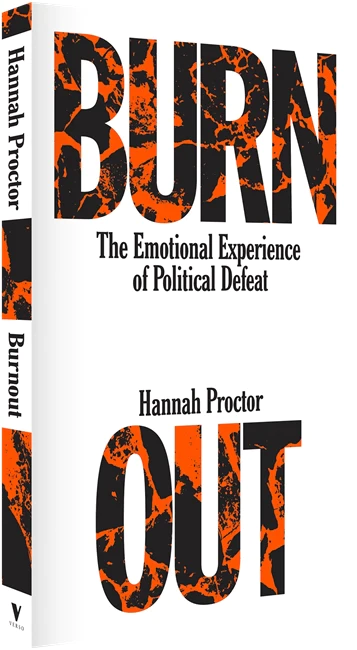
I don’t remember how I came across Hannah Proctor’s Burnout: The Emotional Experience of Political Defeat, but I remember that it took me the better part of a year to read it. This was largely a problem of format, since my copy was an ebook gifted to me by a friend. If an ebook isn’t a library loan or a book club read, then it is doomed to take forever because I’ll treat it as a backup book to pull out in desperate times rather than an active project with a looming deadline.
Burnout was published in early 2024, so Proctor is addressing very recent political events; she began writing it during the COVID lockdowns in response to the electoral defeats of Bernie Sanders and Jeremy Corbyn. The book obviously went to press before Trump’s re-election, however, and I wonder how different the book would (or wouldn’t) be if she had started writing in 2024 rather than 2020.
To quote directly from the back-of-the-book summary from publisher Verso:
In the struggle for a better world, setbacks are inevitable. Defeat can feel overwhelming at times, but it has to be endured. How then do the people on the front line keep going? To answer that question, Hannah Proctor draws on historical resources to find out how revolutionaries and activists of the past kept a grip on hope.
…
Jettisoning self-help narratives and individualizing therapy talk, Proctor offers a different way forward – neither denial nor despair. Her cogent exploration of the ways militants have made sense of their own burnout demonstrates that it is possible to mourn and organise at once, and to do both without compromise.
Perhaps it’s my own inattentive, piecemeal reading that’s to blame here, but having finished the book I’m not sure I can articulate “how revolutionaries and activists of the past kept a grip on hope.” Nor can I really describe the different way forward that Proctor is offering, beyond “quashing the individual for the sake of the movement doesn’t work.” Maybe my brain is simply too melted from easily digestible pop science and self-help books with punchy, pithy bulleted lists to grasp the more complicated or ambiguous solutions she raises.
Even if my brain is fully melted, the historical scope of Burnout still made it a rewarding read for me. Proctor covers a broad swathe of leftist organizing history through eight discrete concepts: melancholia, nostalgia, depression, burnout, exhaustion, bitterness, trauma, and mourning. Each concept is illustrated by specific historical movements or moments, such as exiled Communards as a framework for looking at nostalgia. Reading it felt like catching up on years and years of history that I should have already known about. Now that I have the history in place, I can give it a more careful re-read and come away with a better understanding of the lessons Proctor believes we can learn.
The extended silence here was due to a train vacation throughout Europe—and as usual, another international trip meant time to catch up on my stack of periodicals. First up: Historiskan. Topics included:
The cover story about The Carter Family, the progenitor of country music as we know it today.
The lesbian girlboss and prolific diarist Anne Lister, who nonetheless remained a fervent Anglican Tory her entire life. The duality of man, or something.
Qiyan in the Umayyad Caliphate: women musician, composers and entertainers analogous (though not identical) to geisha.
Continuing on the music theme, the Swedish singer Ulla Billquist. Translating her Swedish Wikipedia page into English looks like a fun project for Future Me.
Women on board the doomed ship Vasa, including a few remains that were misidentified as men. Coincided neatly with an Australian friend’s visit to the Vasa Museum.
La Malinche, the enslaved Indigenous interpreter and consort of Hermàn Cortès.
The Soong sisters, which coincided relatively neatly with my reading of The Dragon’s Village. I’ve been meaning to follow that up with Wild Swans, maybe it’s finally time…
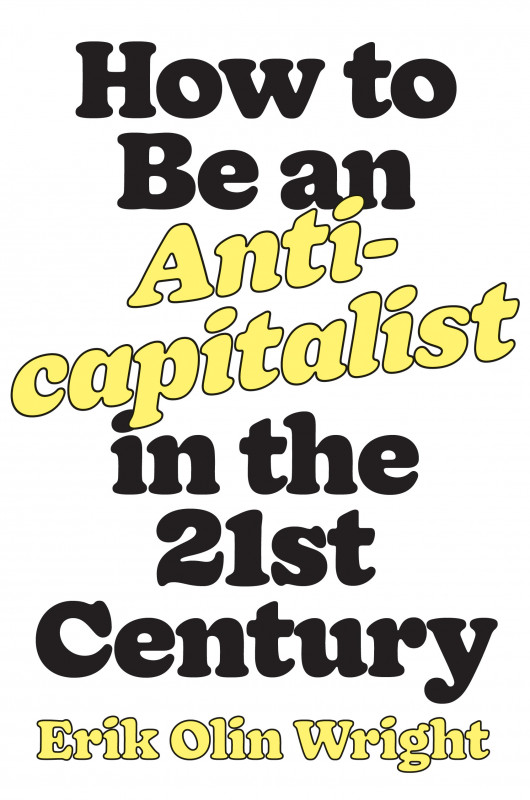
I read this one over the course of several months for a neighborhood book circle, even though it’s short and simple enough to finish in a couple of days. Erik Olin Wright intended this to be a quick introduction for laypeople, free of academic jargon and complicated arguments. Maybe stretching such a thin text over too long a time hampered my understanding of it, but by the end I felt like How to Be an Anti-Capitalist in the 21st Century didn’t deliver on the promise of its title.
I say this as someone who already fundamentally agrees with Wright’s larger project. But a how-to guide includes concrete steps and real-life examples to follow. Wright provides no instruction whatsoever, and for all of his theorizing about how different anti-capitalist (or simply not capitalist) groups and projects can be organized, the only specific example he mentions is Wikipedia. Contrast this with Chokepoint Capitalism,This is an Uprising or Rules for Radicals, which constantly refer back to real life protests and research, picking apart successes as well as failures. When hypothetical alternatives are floated to solve a current problem under capitalism, they are described in very precise terms. You come away from those books feeling prepared and capable of doing something.
A more appropriate title would probably be How to Think About Anti-Capitalism in the 21st Century, because what Wright does well in the volume is defining, categorizing, and organizing concepts. Instead of coming away from the book knowing what to do, I came away from it with better and more precise ways of articulating my ideas. This is by no means an unimportant part of the process of “eroding capitalism” (Wright’s own concept), but it’s not a fulfillment of the promise of the title.
How to Be an Anti-Capitalist… was intended to be accompanied by a denser, more scholarly text on the subject. Wright already had a heavy-hitting career as an academic and had been asked by various groups he’d organized with to write a more approachable popular text. He got that one out of the way first and then died from cancer before he could finish the bigger one. Perhaps that would have had the meat and potatoes I felt was lacking here.
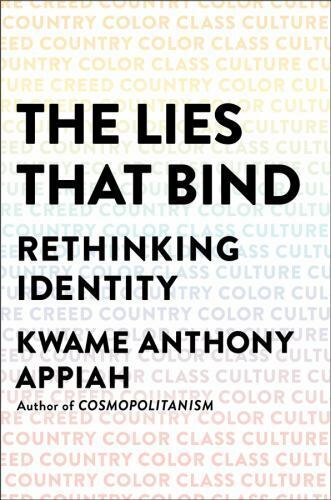
I first came across Kwame Anthony Appiah’s The Lies That Bind: Rethinking Identity in a friend’s Instagram story and thought, “Hm, this would be an interesting book.” And it was, but not in the way I had been hoping for.
Appiah examines the broader concept of identities in an opening chapter (“Classification”) and then breaks down five specific ways that people typically identify—creed, country, color, class, and culture—before giving some end remarks (“Coda”). In each chapter he highlights the inherent instability of these concepts, not just through abstract supposition but also by pointing to historical events and people, like Italo Svevo or Amo Afer, as case studies.
Perhaps the book wasn’t for me because I was already on board with how unstable these categories are. I wouldn’t be able to name any specifics, but I imagine that Appiah’s arguments in places (maybe especially in the chapters on country and color) were also made in Nell Irvin Painter’s A History of White People, which meant that they weren’t new ideas for me. The chapter on creed also left me particularly underwhelmed—Appiah gives a thorough and convincing explanation of why religions are more than just adherence to a particular sacred text, but it seems to be in response to a shallow Internet atheist style interlocutor. Yes, that specific understanding of “religious creed” as an identifier is indeed a bit wobbly, but religion can be defined in other ways besides “adherence to a particular sacred text.” Those more nuanced understandings go largely unaddressed.
I think I also was going in half expecting a diatribe against what’s lately been termed “identity politics,” but Appiah never goes that far, either. He does raise skepticism about appeals to diversity within political parties or companies, but never more than mild commentary as an aside to the larger point. I went in spoiling for a good debate and instead got an explanation of things that more or less aligned with the views I already had.
Instead, the most engaging parts for me came in the initial Classification chapter, where Appiah sets out a working definition of “identity” for the book and where he thinks identities fail. In his view, identity markers are a rough shorthand for group assignations we can sometimes choose for ourselves and that we sometimes have foisted upon us. If I’m a Muslim, I have a very clear idea about what it means for me to be a Muslim. I also have a clear idea about it means for other people to be a Muslim. At the same time, other people have their own ideas about what it means for someone to be a Muslim. So far so good, if slightly chaotic. But because individual ideas about “being Muslim” will never coalesce into a universally accepted definition, things collide. I might consider myself Muslim while other Muslims do not; someone can also consider me a Muslim when I’m not in reality.
This kind of sloppiness might be surmountable or at least tolerable on its own, but identities run into another thorny problem: essentialism. By this Appiah is referring to the philosophical idea of “essences,” that people (or things, or animals, or etc.) possess immutable, timeless qualities. Mash this up with identity labels, and this means that we think of any given identity marker as arising from an eternal and immutable characteristic of the person with said identity. To continue on the Muslim example, people tend to think (or to act and speak as if they think) there is a Muslim-ness that all Muslims share, that it is an eternal and immutable thing. Essentialism, Appiah theorizes, works more or less fine for simple concrete things like cups or chairs, but it can’t hold for identities. There’s too much variation, even contradiction, within any one group.
But even though essentialism is presented as the single most important reason to rethink identity, it’s only addressed head-on in the introductory chapter. Appiah refers back to it occasionally in later chapters, but not in any strong sense. If illustrating the inherent instability of identity labels was meant to be the argument against essentialism, I don’t think it’s a very convincing one.
This might be a problem where I’m expecting popular philosophy, or popular political science, to dig into a topic at an academic level. That’s simply not the job of a popular book aimed at a lay reader and the problem is my own expectations. If a book like The Lies That Bind is meant to be an introduction that inspires readers to seek out more robust texts, or even just to reconsider their own ideas, then that’s fantastic no matter what I think of it. After all, The Lies That Bind is also an interesting and engaging read. Appiah has a knack for effective framing devices and clear, concise explanations. Perhaps the fact that the book grew out of lectures also helped give it a light, conversational tone.
As someone described How to be an Anti-Capitalist in the 21st Century, it’s a good book to give to your centrist friend. But if you’re already convinced of the instability of identity markers then there’s not much new here for you.
I’m increasingly deliberate about the physical books I buy to add to my library these days. My bookstore browsing always involves me checking what’s available at the library before making a final purchase. And I make a final purchase more often than not! Just less impulsively. Bookstores function as an important randomizing factor in a world with algorithm-based recommendations. The human element is key.
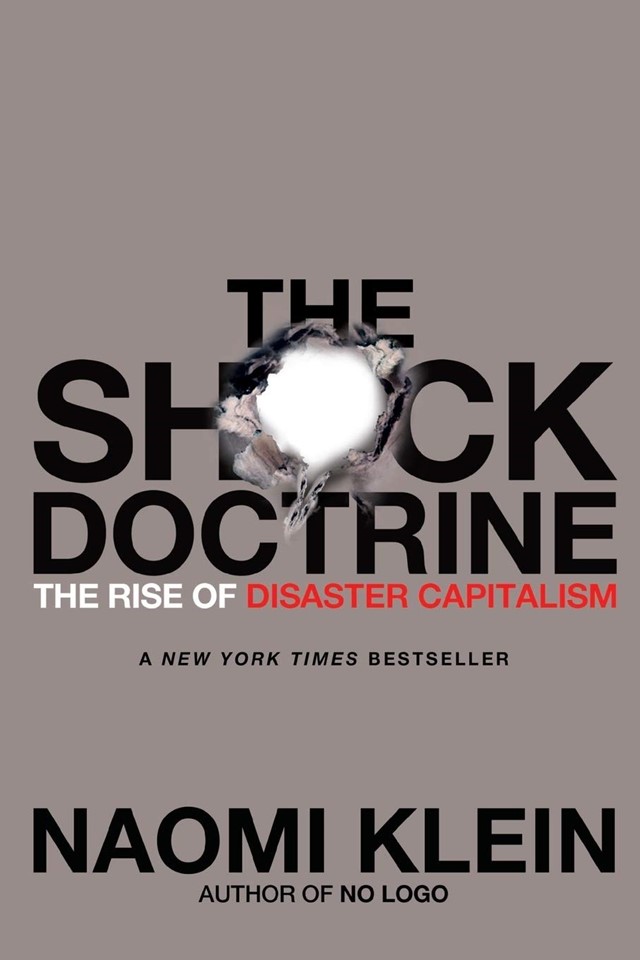
A recent trip to The English Book Shop in Stockholm—which also reminded me that I had put Sister Outsider on my TBR—brought Naomi Klein’s The Shock Doctrine back to my attention. I’d seen it countless times in friends’ libraries, and Klein as a journalist was already familiar to me, but for whatever reason this was the moment where I decided to actually read one of her books. And as luck would have it, it was available in English from the Stockholm library.
The Shock Doctrine is a comprehensive look at the spread of Milton Friedman’s free market philosophy in the latter half of the twentieth century. I could list all of the case studies Klein takes up, but it would get long, fast. Suffice it to say that she draws on examples from all over the world. Her main thrust, however, is showing its most recent (at the time) application in the post-9/11 invasion of Iraq.
The distinctive element of Klein’s approach (compared to, say, The Jakarta Method) is her use of metaphor to frame her research: in this case, the gruesome techniques used by Donald Ewen Cameron in the Montreal experiments. The connection Klein repeatedly makes is that massive disaster (either man-made or natural) visited on an entire population is, if not the only, then the easiest or most direct way to traumatize a country enough to sneak in wildly unpopular changes—the ones she happened to focus on here with economic ones rooted in the Chicago school. Much like Cameron used electroshock therapy and other techniques in an attempt to turn his patients into blank slates upon which he thought he could rebuild them into healthy people, Klein argues, the US used the shock of these disasters to turn entire countries into blank slates upon which to build new highly privatized ultrafree market economies specifically to benefit the ultra wealthy (usually but not always located in the US). In other words, “disaster capitalism.”
She’s received criticism for this choice of metaphorical framing device, which isn’t entirely unwarranted I suppose, but personally I think the metaphor is an apt one. It allows Klein to highlight the common factors of a large number of disparate tragedies and make sense of the bigger picture and it’s also not entirely unrelated, considering how those electroshock techniques were often applied in the campaigns of violence Klein describes throughout the book. Fractal violence.
My only lingering thought, since this was published in 2007, is whether or not Klein’s attempt at optimism in the final chapter ended up being warranted. In what I assume was a deliberate choice in order to leave readers with a sense of hope for the future, she closes with developments in South America she feels will help create “shock-proof” countries and economies and lead to more just and equitable outcomes. This was a chapter written before Bolsonaro or Milei rose to power, obviously. Since there doesn’t appear to be an updated edition, for the moment I’ll just have to hunt down subsequent interviews and op-eds.
Numbers are hard. I realized sometime in November that I had miscounted my progress in my “ten books I already own” goal and began scouring my shelves for something short that I could knock out.
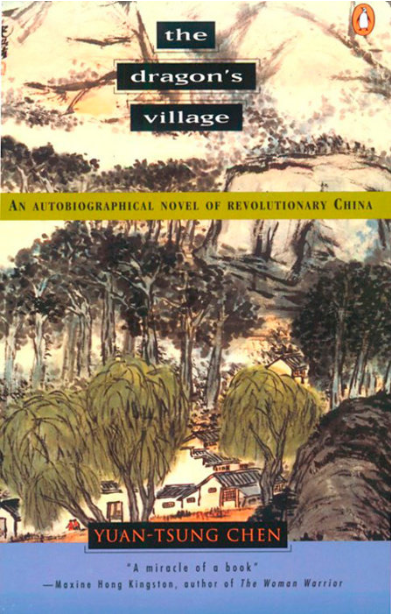
Enter the dragon. Or technically: YuanTsung Chen’s The Dragon’s Village.
This is yet another stop on the “selections of bookstores past” tour: I picked it up from What The Book? in Seoul in its glory days, at the airy and well-lit second-floor location overlooking Itaewon-ro. Pour one out. Press F to pay respects.
In my mind’s eye, I can still see the shelf where I picked it up, and I can remember that my decision to buy it was because I knew nothing about Chinese history generally, recent or otherwise, and that reading about the land reform and the Great Leap Forward seemed like it would be a good self-improvement project.
It just took a while!
The Dragon’s Village languished unread in my library for over a decade. I started a couple times but couldn’t get into it. Now with my arbitrary deadline looming, I got to work and pushed through my initial resistance to finish the book.
The setting is 1949 China. The 17-year-old narrator, Guan Ling-ling, joins a revolutionary theater group and is sent to the remote village of Longxiang in northwest China to help carry out the land reform. The Dragon’s Village follows her trials and tribulations as she works alongside party cadres and sympathetic villagers to establish what they hope will be a better, more just, more equitable world. Chen frankly describes the misery of peasant life and the bleakness of the landscape, setting the context for why—at least in certain regions—the promise of land and wealth redistribution could gain the foothold it did. She also bluntly chronicles the obstacles and setbacks she and the other party cadres face, and equally sets the context for why the redistribution plans didn’t gain even more of a foothold. Through the novel we become witness to a pivotal moment in time, full of potential, when things might still have been otherwise but yet were not. It ends before anything has truly been settled, on a note of optimism and hope that still carries the weight of historical inevitably, as Ling-ling is speaking to an elderly and utterly destitute village woman:
“Da Niang, come. Come and get your land. It’s time.”
Chen’s style is hard to enjoy for its own sake, and even when I was deep into the story I was reading on despite the prose, not because of it; at best it didn’t get in the way. As far as I can tell, Chen wrote the novel in English, so there’s not a matter of translation at play here (officially, anyway). The phrase I kept thinking of to describe her style was “flat affect,” where the emotional tenor is always subdued almost the point of nonexistence. The other thing that put me off at first, but gets better as the novel progresses (mostly because people just talk less), is the tendency for characters to infodump during dialogue in a way that doesn’t sound like how anyone would actually talk.
Chen is very clear that this is a novel that draws from real life. “The story is fiction, but it is true,” is how she describes it in the foreword: a roman à clef. How real are the peasants we read about? How have their stories been refined, joined together, teased apart to become the people that Ling-ling meets? While the specific character we read about known as “the virgin widow” might not have a one-to-one correspondence with a single person who lived and died on this earth, the circumstances of her life were no doubt real for countless women. As an amalgamation of their biographies, the fictional virgin widow becomes true.
Or, maybe, in this case Chen drew on one very specific person she met in her land reform experience. Who knows!
This kind of blurred line, or overlap, between fiction and true didn’t bother me as much as it did in, say, Ali Smith’s Summer. Actually, it didn’t bother me at all. The Dragon’s Village is a novel but it reads more like a documentary or a diary of historical experiences and events, while Summer is a fictional plot specifically crafted to deliver a rhetorical (dare I say political?) point. “Based on a true story” is a lot easier to swallow if what follows at least gives the appearance of neutral documentation rather than rhetorical posturing.
(The more I reflect on Summer, it seems like the less I like it. Ouch.)
Of course, as an account of one of the major global political events of the twentieth century, The Dragon’s Village can’t really be read non-politically. I don’t know the background to the novel’s publication, or the waters Chen had to navigate to get it published, but I have to assume it was tricky. Ling-ling is presented as an idealist who believes in the revolution and who wants to help the people she sees living in abject poverty, but she also clearly distances herself from the extremes of Maoist cult of personality. At one point she is distressed to see that her elderly hostess Da Niang has replaced an image of the kitchen god on the wall with an image of Chairman Mao. Not because Ling-ling has any allegiance to the folk traditions encompassing the kitchen god—she considers them all superstitions—but because she is wary of what the single-minded adulation of Chairman Mao might lead to.
I went and Googled “Chinese kitchen god” so you don’t have to.
The story is fiction, but it is true. Does this moment in the book reflect an exchange or insight Chen had in the moment? Was it a flourish she was encouraged to add to a novel that might otherwise land as not hostile enough to Maoism?
Chen’s other books also seem to be largely autobiographical (The Secret Listener and Return to the Middle Kingdom), and with The Secret Listener (published in 2021!) the criticism leveraged against her seems to be based in this blending of fact and fiction. I want to have something intelligent to say here about who is criticizing her for what and what any given audience expects out of an account of Maoist China but I’m fresh out of brain. An interview with the New York Times only vaguely mentions that it’s men calling her a “fabulist,” but no names or further details are given, and I’m too tired to research. As it stands, for me The Dragon’s Village is a valuable primary-ish source for a very singular moment in history. When I decided to really sit down and finish the book, I assumed I would toss it on the giveaway pile afterwards. But there is something about it that I want to keep in my library. Warning? Reminder? Enigma?
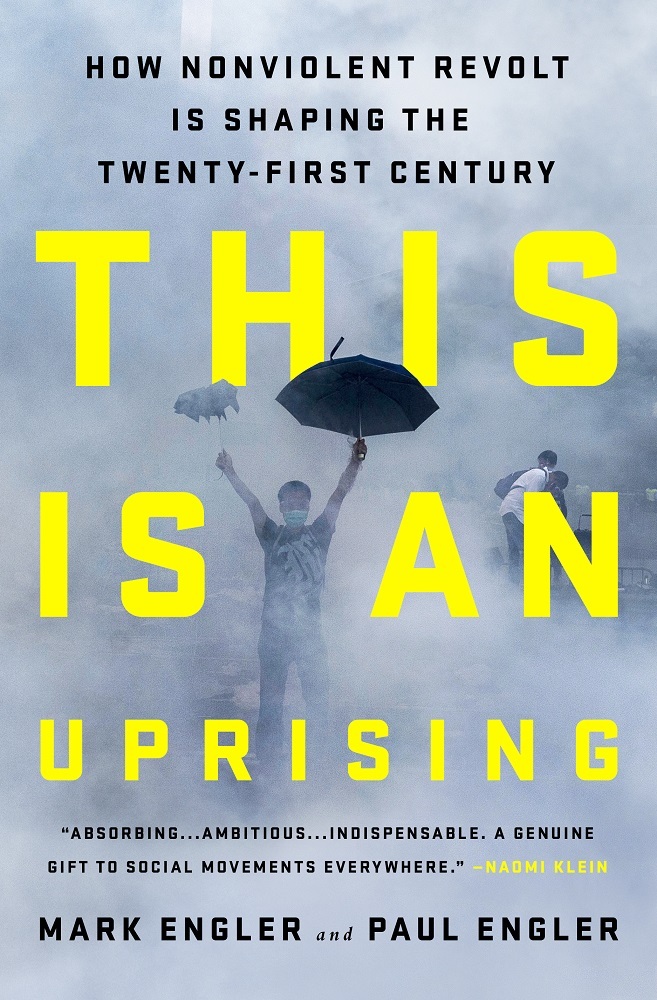
A guest on an episode of one of my favorite podcasts a few years back mentioned Mark and Paul Engler’s This Is an Uprising and it went on to the TBR. I managed to find a copy at Judd Books during my trip to London this past summer, and recent events have made it seem especially relevant, or more relevant than usual.
This Is an Uprising is a handbook and history lesson in nonviolent revolt, looking at various twentieth century case studies through the lens of nonviolent protest theory and evaluating notable successes as well as failures. The Englers review the two traditional models of protest activism, organizational-based and movement-based, and then propose a third model that combines the strengths of both of them for the best possible outcomes: momentum-based. The Englers did their homework and there are a lot of references to names like Saul Alinsky, Gene Sharp, and Frances Fox Piven. (Which also meant that, despite clearing one book of my TBR, I’ve now added four others, but that’s what the best nonfiction always does.)
This was also a welcome counterweight to Weil’s meditations on force. The Englers devote a whole chapter to outlining what they call discipline, that is, the commitment of individuals and movements to nonviolence. They highlight how violence—which they specifically describe as “whatever the public perceives as violence”—makes widespread acceptance of a movement more difficult, and how violence is often the wedge that allows state-sponsored infiltrators to compromise groups. From local criticism of Black Bloc members in Occupy Oakland to FBI infiltrators hosting bomb-building workshops for environmental activists to the habit of guerilla fighters of installing yet another military dictatorship, the Englers make it clear that nonviolence is an essential part of the revolt they’re detailing. While there’s a lot of compelling evidence in This Is an Uprising for Weil’s argument that force eternally begets force, the book also shows that transcending force—often by tactically submitting to it in the hope of garnering support or changing public opinion—is achievable by more than just two or three people in the course of human history, and that it can have serious and long-lasting outcomes.
Could the tactics outlined in this book have worked against Hitler and the Nazi party, though?
I’m not convinced.
While the Englers did a fair job highlighting mixed successes or outright failures (and explaining them according to their failure to implement the most important principles of momentum-based activism), I don’t think they ever tackled the hardest possible cases. Situations where the status quo to be changed is the absolute bones of how our society runs, the underlying principles from which everything else springs.
The successful protests in here, even the most impressive case of Otpor and the ouster of Slobodan Milošević, were all leveraged against situations that can be considered something like social byproducts of the deeper, more entrenched forces guiding the world. I’ll be less cryptic and tip my political hand by more explicitly defining those “deeper, more entrenched” forces as “the profit motive of capitalism as it overlaps with the state.” Segregation and Jim Crow laws were not inherent cogs in the profit machine. Nor were there any obvious financial incentives to banning same-sex marriages or the callous treatment of HIV and AIDS patients. These are huge, important, material concerns for millions of individuals that can have serious, even life-or-death consequences, absolutely. I wouldn’t wish to suggest that they were unimportant. But at a higher level, one could make the argument that these issues were always political footballs at the end of the day, kicked back and forth to show allegiance to this or that team, means to the true end: acquiring and maintaining a hold on political power and wealth.
Think of the cynicism with which the Republican party made abortion a huge issue for American Christians so that they could ensure a reliable voting bloc for themselves and the ability to, not make any laws about abortion out of a fervent true belief, but to craft legislation and economic models that would keep wealth and power consolidated with an elite ruling class (with a few token abortion decisions here and there). A ruling class you could, for example, call “the 1%.” Abortion was and is rarely the endgame for many (most) Republican politicians, which is why no one should be surprised when the same Republican politicians urge their daughters or mistresses to seek out abortions if a child would be politically inexpedient. It’s just the means to an end. The minute they can’t use abortion as the same galvanizing topic to get sympathetic voters to the polls, they’ll drop it and pick something else. Abortion I guess is still on the table now, but segregation no longer is. (Weirdly, with the “your body, my choice” meme, it seems like abortion has mutated or grown to become, not necessarily a purely Christian thing, but also specifically a feminist backlash thing. But anyway.)
If a change in law or regime happens to align with peak protests, is that really a victory? Is it causation or merely correlation? I suppose, after all, that it takes exactly these kinds of nonviolent protests to shift public opinion in such a way as to make something like segregation or same-sex marriage bans so toxic that it’s political suicide to promote them. I guess my concern is: material as those concerns are to millions of people, does changing them really get to the heart of what’s going wrong at the top? Are we just condemned to constantly putting out forest fires of different forms of social oppression (see: the explosion in discussions on trans rights) as long as elites remain addicted to wealth and power? Are we treating symptoms rather than the disease?
Maybe I’m wrong. Maybe Otpor’s successful overthrow of Milošević is an example of what could have happened earlier on in 1930s Germany if the right people with the right ideas had deployed the right tactics. But while I appreciate the inherent optimism of This Is an Uprising, I worry that there is a limit to the success of the model the Englers are proposing.
Cookie Consent
We use cookies to improve your experience on our site. By using our site, you consent to cookies.