
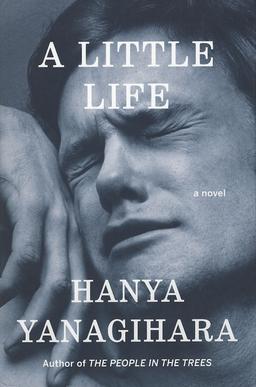
This one was an absolute beast. Not only is A Little Life incredibly long (814 pages!), but Hanya Yanagihara does not relent when it comes to some really viscerally awful stuff, described frankly and in detail.
I remember the hype around this book, the Man Booker and National Book Award shortlists, the actual Kirkus Prize, the mentions in book blogs (it was released during the peak of my book blog consumption), and thinking, “Okay, I’ll give this one a shot at some point.” People whose taste I trusted—including the friend who sent it to me—had loved it.
And well!
I might have picked a bad time to read it. I don’t mean only because my brain has been absolute mush lately, and not up to the task of an 800+ page doorstopper. I also mean that I might have put it off for too long, that in some ways A Little Life was a hype book of its time that seems irrelevant or outdated in 2026. Either way, by the end of the book I was just so frustrated that I was hate-reading, occasionally hate-skimming; it came with me on vacation in part so I would feel obligated to finish it to save myself from having to schlep it back home.
A Little Life follows a friend group that is, at least in part, based around a mysterious young man named Jude St. Francis. Yanagihara drops hints about a traumatic, impoverished childhood for Jude straight away, but we don’t find out the whole story until somewhere around maybe 75% of the way through? They meet in college (maybe grad school? time is fuzzy in this book) and their friendship continues until their early 50s, when the book ends. They also all become incredible successes in their fields: Jude as a lawyer, his friend and later partner Willem as an actor, Malcolm as an architect, and JB as an artist.
That long timeline is itself one of the things that doesn’t sit right with me. I did the birthday math; if we assume that the most recent years in the story are contemporaneous with publication, the characters in their early 50s in 2015 would have been born in the early 60s. Maybe, at best, the early 70s: apparently the first-person chapters are set nine years in the future from a specific incident in the book. But the setting always feels like a perpetual now because there is absolutely nothing in the background to mark the passage of time. Vietnam? Reagan? AIDS? The Cold War? The Internet? Star Wars? September 11th? The Matrix? Smartphones? The Gulf War?
The discussion about how much or how little the real world should turn up in novels will never be settled; how one should balance the risk of sounding dated or aging like milk versus coming across as unrealistic or just plain weird. For the sake of taking the most charitable stance possible, I’ll assume that Yanagihara specifically chose the more detached, unspecified timeline so that A Little Life can slowly drift through various turmoil and upheavals and remain more or less ageless, focused on the relationships between the characters rather than historical specificity and accuracy.
But the result is that characters live through historical moments without ever commenting or even reflecting on them. Gay men during the 80s not once mentioning AIDS? Black characters not reckoning with the LA riots in the early 90s, or Obama’s presidency from 2008 through 2016? Queer characters not reflecting on the same-sex marriage debate of the early 2000s? New Yorkers and 9/11? Beyond those very obvious omissions, the characters seem to have perpetual mid-2000s liberal sensibilities even as college students in the late 70s and early 80s, which makes them feel kind of flat and perpetual.
The downside to that choice, also, is that the Trump era has put a hard stop on the timeless plausibility of A Little Life. While it’s entirely possible to imagine the last years of the book being, say, 2003 or 2008 as easily as being 2015, such political indifference among these particular characters is impossible to countenance in 2016 or beyond. It’s no fault of Yanagihara’s, of course, but it’s still a consequence of the “fuzzy timeline” choice. The relentless march of history thwarted whatever Yanagihara’s aesthetic goal may have been in making it timeless, so she might as well have not.
I don’t think I would have such a quibble with the timeline weirdness if I didn’t think it was wholly unnecessary for what the book seems to be about (i.e., Jude). There is the very, very slow evolution of Willem and Jude’s relationship as they move from friends to lovers, which could have possibly been interesting, but I don’t think Yanagihara conveys it very well. Speaking to that perpetual mid-2000s liberal sensibilities, Willem is very chill and blasé about entering into a homosexual relationship with his best male friend. I have the advantage (if you can call it that) of being twenty years younger and growing up in very different environment, but even so I don’t think I would be half as chill and blasé about fundamentally altering such an important relationship, never mind rethinking my entire sexual identity—but then again, I’ve always joked about being the world’s straightest woman, so maybe that’s a me problem.
Nevertheless, if you’re not really going to use such a long timeline to your advantage and really grapple with some soul-searching, then you might as well just chuck it in the bin and start the story way, way later. You have 800 pages of material! You’re going to hit your wordcount minimum!
I’d also like to ask men who read A Little Life what they thought about it, or rather specifically how they felt about Yanagihara’s portrayal of male friendships. While I’m always going to struggle with how friend groups are written and idealized because they don’t seem to reflect my own friend groups (such as they were, or rather weren’t), the dynamics of the group were odd. The story goes out of its way to mark the four of them as special, something like a clique or some kind of aspirational guy gang that the world at large has declared Important. All of their classmates and friends instantly recognize the four men as some kind of unit, like they’re broadcasting BFF radiation for everyone to pick up on, and I can say without a shadow of a doubt that I’ve never detected that radiation from a friend group I’m not in. I don’t think this is Yanagihara doing anything subversive or clever here; I think she’s just using that as a sort of shorthand for saying, “See, these guys really are great and close friends!” The dynamics of whether people keep just one central group of friends their entire adult lives is also complicated; in my own experience I have a few different “friend groups” as such, but just as important to me are the individual friends who only have a one-on-one relationship with me. All of that is without bringing the question of gender into it—it’s no secret that emotional vulnerability and intimacy between (mostly) straight men is a complicated topic.
And, finally, the topic of Jude, who really seems to be the whole point of this story. Given all of the implausibility I just mentioned about the nature of these men’s friendships, I have to add: and what in the hell did they ever see in Jude? In each other, arguably: they don’t necessarily have a lot in common, we don’t see them go through any bonding experience or anything like that; their journey to mutual deep and abiding friendship is as quick and glossed-over as a children’s cartoon.
(Aside: I hate that I’m using shows like My Little Pony: Friendship is Magic or Magic Knight Rayearth to make this point. I’m sorry these particular pop culture touchstones live in my head rent free. But Yanagihara’s writing in that regard is really that shallow and I can’t find any better comparison. “I just met you ten minutes ago but you’re my friend for life!”)
Jude in particular might stand out in that regard because we spend the most time with him, I don’t know. Or maybe because he has the most problems, or gets into the most trouble. JB and his drug addiction come in second place; Willem and Malcolm are, by contrast, very normal and drama-free. Jude is certainly incredibly gifted—he’s absurdly good-looking, as Yanagihara never tires of reminding us, and he’s a gifted singer and cook and baker in addition to being a world-class litigator—but the gifts that make a genius are not the same gifts that make a good friend. There’s an off-hand remark from Willem at some point about what a good listener Jude is, I think, but not much more than that. He might have tutored them in math occasionally? Nonetheless they go to the ends of the earth for him. And it’s not just his Hood Hall crew! As an adult, nearly everyone he meets decides to descend upon this very special boy and shower him with attention and help and care! He finds a doctor who treats him at no cost for his entire adult life; one of his professors, aware of Jude’s status as an orphan, adopts him; the aforementioned friend group that fawns over him; randos who do pro bono legal work with him adore him and provide him with a fashionable, handicap-accessible living space.
(Exception made for the abusive boyfriend Caleb, but he’s cartoonishly evil the point of melodrama and dies from pancreatic cancer anyway.)
Who in the history of anything gets that much attention and support and validation except nepobabies?
Of course, the problem with disliking Jude as a character is that he is the trauma sponge of the book, and disliking him feels like kicking a sack of puppies. To be clear, it’s not the character I dislike so much as Yanagihara’s use of him. His life at the monastery, and even the later child prostitution with Brother Luke, was within the realm of possibility for me. Even the continued sexual abuse at the orphanage and the perpetual horniness of long-haul truckers. I’m familiar enough with that sort of thing—between volunteering at a non-profit that used to facilitate international adoptions and later working on reports for similar child-focused NGOs—to know that vulnerable children, especially ones without safe adults in their lives, can suffer years of sexual abuse and exploitation. It’s a hard pit to get out of.
But the final destination in Philadelphia, with the pure sadism of Dr. Traylor, made it all too much. It’s unclear to me what that final episode is even supposed to add to an already-traumatized character. If it was important for Jude to have a physical disability, he could have been born with one, or been injured while hitchhiking. Why Dr. Traylor’s “Most Dangerous Game” trauma? It was also just lazy writing: Yanagihara does the literary fiction version of “a wizard did it” and “somehow,” “eventually” Jude ends up in Traylor’s car after collapsing by a bush or along a road or something somewhere. Somehow, Palpatine returned. What is the point of heaping misery upon misery on a character? Is she trying to build the case that really, Jude was justified in taking his own life? I don’t know.
The Internet suggests that there is at least one interview with Yanagihara somewhere, maybe several, where she describes her intention with A Little Life as an explanation, of sorts, for the loved ones of suicide victims: it’s not your fault, she purportedly wants to say. Some suffer, and have suffered, so much that there’s nothing anyone can do to save them, and suicide is a sympathetic and valid option. I haven’t found the interview(s) in question, and I don’t care to, but I’m willing to take that as a possible explanation for why the book is the way it is. I can’t say that it improves my opinion of it at all.
I always do a little bit of Internet sleuthing after I finish a book to get a sense of what other people thought about it; I’m curious like that. This time my Internet sleuthing was also to dig up whether or not Jude and his trauma was inspired by some kind of real-life incident I hadn’t heard about. I’m not sure that writing a story inspired by those kind of events should end in the survivor killing themselves, but on the other hand, if the real-life person had done the same the story choice could maybe be justified. The People in the Trees, for example, was based on Daniel Carleton Gajdusek; this wouldn’t be her first roman à clef. (Though, a bit weird to do back-to-back books about child molestation, maybe…)
Nope, not this time. Everything in the story seems to be fabricated wholecloth from Yanagihara’s imagination.
Okay then. Did Yanagihara have any past experience as something like a social worker, or in child protective services or similar, to give her familiarity with the kind of horrors that can befall children like Jude who fall between the cracks?
Wikipedia is hardly an exhaustive source, but it only mentions that she worked as a publicist after college alongside writing and editing jobs at Condé Nast Traveler; I think it’s safe to hazard a guess that no, she hasn’t spent any time working with young people in Jude’s position.
Nor was there, after all the tragedy and misery, any indication at all of research on Yanagihara’s part when it comes to trauma, childhood sexual abuse, grooming, mental health, hell even Jude’s complex medical problems. Literature is allowed to be fiction, and to take liberties and poetic license; I’m not about to demand over-the-top Soviet-era realism in every story. But I think when you mine human misery so extensively for the sake of writing a book, you owe it to your readers and to anyone who’s gone through anything remotely similar to be able to prove some kind of…familiarity? respect? due diligence? There is an entire afterword in Jag heter inte Miriam where Axelsson gives at least some of her sources and recommended further reading, for example, even as she makes it clear that the specific story she told about the Holocaust and the 1948 Jönköping riots is entirely fictitious.
I’ve lived a life blessedly free of anything even remotely resembling what Jude endured, so I’m not about to make proclamations about what Jude’s characterization means for abuse survivors (or anyone with similar mental health struggles or physical disabilities). I can only say that as a reader, I find Jude’s character to be a cheap ploy for emotional manipulation and that there’s nothing I despise more in books (or movies, or TV shows) than cheap ploys for emotional manipulation. It’s lazy, hack writing and it diminishes real-life suffering.
