State Tectonics

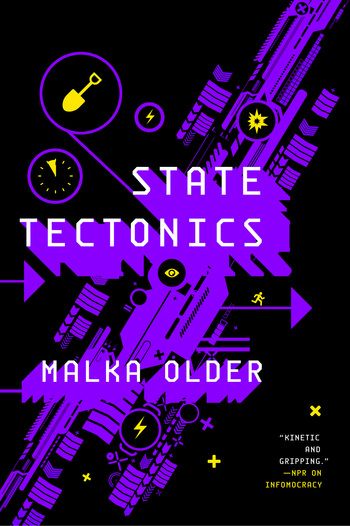
State Tectonics marks the first time I’ve finished an entire new trilogy since I finished The Obelisk Gate back in 2017? 2018? (And we’ll overlook, as well, A Desolation Called Peace, which is so bound up with A Memory Called Empire  that I’m pretty sure the two novels started as one gigantic tome.) Genre fiction as of late has the bad habit of turning everything into series of some kind or another, and when my reading life is already navigating the tension between the scope of my ambitions and the limits of my time, series are the last thing I need. But I was so taken with Malka Older’s cyberpunk-y political thriller and the complex electoral near-future she had imagined that I went ahead and finished the next two books, though at this point if she comes out with further installations I will declare myself done. Not because I doubt they’ll be good, but because I only have so much time on this earth.

Like she did with Null States, Older jumps ahead to a few years after the previous book left off. It’s election time again, the same as in Infomocracy, and this time the sprawling tech giant Information itself is under attack. Rogue physical assaults are being launched against Information servers and hubs around the world; unsanctioned communications channels designed to go undetected by Information have been figuratively as well as literally unearthed; mysterious individuals are roaming around cities and handing out self-destructing paper copies of “local guides” that claim to be better sources of information than Information itself. Who is responsible? What’s their end game? Is it an inside job? How will all this affect the upcoming election? Again, like in Null States, Older expands perspectives to include secondary characters we haven’t spent much time with before—Maryam, a Muslim lesbian techie who first appeared on the side in Infomocracy; Amran, a young and inexperienced Sudanese Information employee introduced in Null States—while touching base with previous perspective characters like now-married, now-pregnant Roz from Null States and Mishima from Infomocracy.

I would recommend reading all three books in pretty close succession, if only to keep the rather large cast of characters straight in your head, particularly the side and secondary ones. My timing didn’t quite work out, so while I read Infomocracy and Null States back-to-back, I took six weeks off in the middle of State Tectonics to go on vacation (and I wasn’t about to bring a hardback library book with me in my carry-on luggage). Whatever nuance I failed to grasp because I forgot who was a member of which political party who had broken up with whom wasn’t enough to make the broader strokes of the action impenetrable to me, and quite frankly I just plain have fun spending time in the world to which Older has obviously given an incredible amount.

Without getting into serious spoiler territory, I will say this: State Tectonics is an incredibly satisfying ending that is on brand with how the geopolitics in the series have developed and shifted across all three books. People who are better at intrigue than I am might be able to guess where the story is going, but for me the ending was well-earned. Older sticks the landing, no doubt about it.

Orlando

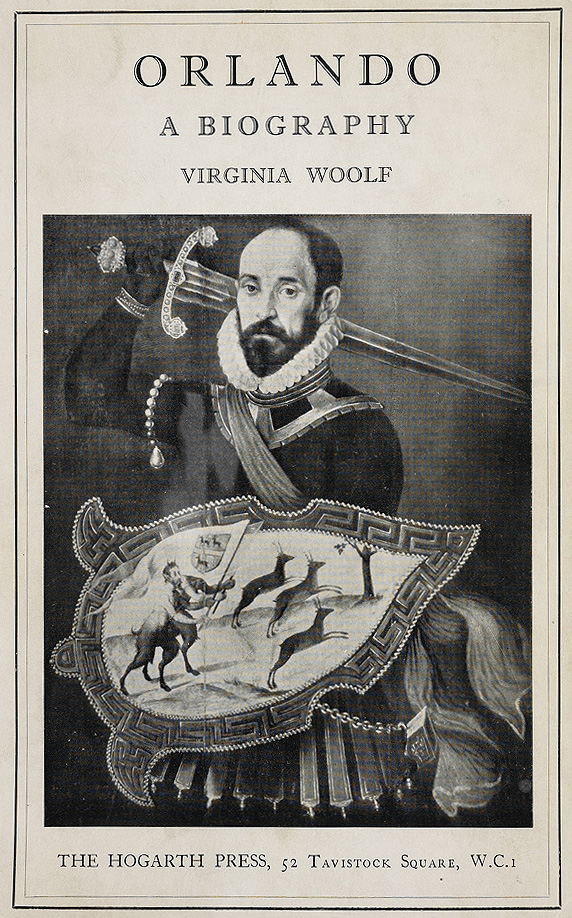
As established in my StoryGraph Wrap-Up post, the Austin Feminist Science Fiction Book Club is responsible for just about 25% or so of my reading every year. Here’s me getting a head start on the first meeting of 2023, finishing Virginia Woolf’s Orlando right at the end of 2022.

As this selection might imply, the Austin Feminist Science Fiction Book Club applies a very generous definition of “science fiction.” This is only a good thing, in my opinion, because it keeps things fresh and varied. I have no complaints about Orlando being included and I think I even voted for it in our poll.

I just wish I could like Virginia Woolf.

I don’t understand what my problem is. I love Mrs Dalloway, enough that it’s one of the few books I’ve re-read in my life, but anything else I’ve ever attempted just leaves me cold. “Why aren’t you Mrs Dalloway?” I lament as I read, until I either finish the book (Orlando) or give up on it entirely (To the LighthouseA Room of One’s Own). Is it a disconnect of time? Culture? Class?  I’m reminded of my colleague’s complaint about Thomas Savage: “You love yourself too much, book.”

I won’t dispute Woolf’s place in the English canon, her role in feminist literature, or the esteemed reputation she enjoys today. My point isn’t that she’s Objectively Bad, Actually or Extremely Overrated (I save that hot take for Jane Austen!). I think she is, on balance, very well deserving of her posthumous success and reputation. I just lack the necessary receptors in my reading brain to actually enjoy her writing.

The Big Balloon (A Love Story)

I decided to get an early start on some classic New Year’s resolutions like decluttering and ending long-term toxic relationships by having an emergency gallbladder removal two days after Christmas!

Medical drawing of a gallbladder
This one does not spark joy!

It also left me with three and a half days of nothing to do but chip away at my ebook collection; I didn’t take my purse and its ever-present paperback with me to the ER, as I fully expected to return home the same day. Well, well, well. Fortunately my phone is a miniature library of obscure and half-forgotten ebooks and I could keep myself distracted in the long waits between ultrasounds and discussions with surgeons. Most of that time was spent with the back half of Rick Berlin’s The Big Balloon (A Love Story), which up to that point I’d been reading on my morning commute.

I’m not hip to the Boston art scene, I didn’t know who Rick Berlin was before I bought the book, I’d never heard of any of his musical projects. But he put out an ad for the book on one of my go-to podcasts and since the premise sounded unique, or at least interesting, I decided to give it a try. I feel that’s only worth mentioning because someone who’s either a fan of Berlin, or familiar with his artistic milieu, will probably have a different response to it than I did.

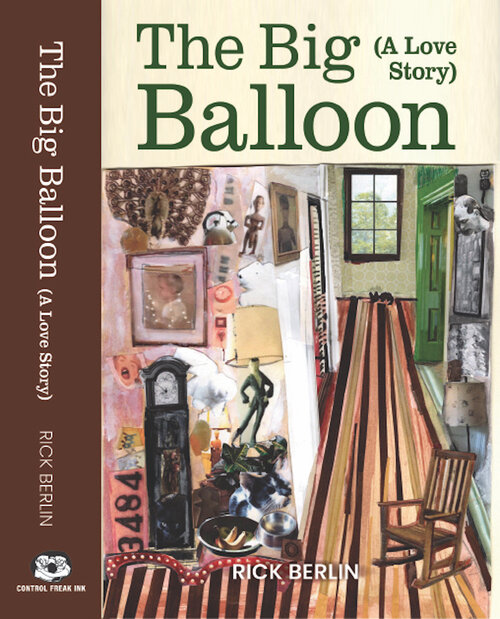
Out of every possible Pandemic Project or Pandemic Novel, The Big Balloon is maybe the only one I can imagine that will be at all tolerable to revisit in more normal times (if we ever have more normal times). Even though the book is the direct result of COVID-19, it’s never about COVID-19. The conceit is simply this: The Big Balloon is a collection photos of items around Berlin’s home and reflections, stories and reminisces related to each item. Each little essay is entirely self-contained, with no attempt to impose chronological or thematic order on the collection (aside from organizing it into chapters based on rooms). The result is like a literary version of a Cubist portrait, where different years of Berlin’s life and different aspects of himself are presented simultaneously—or as close to simultaneously as you can get in something you read. Something about using the limitations of lockdowns to open up a vast interior world, etc. etc.

The Big Balloon worked well for commute and hospital reading because each essay was never especially long, so I could dip in and out according to subway arrivals or morphine-addled focus. And that was precisely the intended effect:

There is no linear structure to this book. No over-arching narrative. Each entry is self-contained. One piece can relate to another, but it isn’t necessary to make that connection. The reader can pick it up, crack it open anywhere, read a section and put it down. The ‘chapters’ are just the rooms in my house.

It could be said that I chose this odd-ball format for bathroom reading. For those with short attention spans. On the other hand, much as I love the twists and turns of a full blown story, the Haiku simplicity of disparate entries exposes Berlin as if opening the paper window flaps of a Twelve Days Of Christmas holiday card in no particular order.

The highly personal nature of the material also, in a way, made up for the fact that I wasn’t allowed to have any visitors. I wasn’t exactly starved for social contact generally, between the two other patients sharing my room and chatting with the nurses doing their rounds, but that’s not the same as time with your nearest and dearest in the darkest, coldest days of the year. The next best thing was Berlin plunging right to the depths of his own psyche to share with me, and the rest of his readership:

The Big Balloon is super personal. Most art, at least the art I love best, is personal. From another’s truth one extrapolates one’s own echo, wisdom, embarrassment and laughter. That’s what I’d hope for you, dear reader. That you’d laugh or at least find something self-relevant in these independent passages of my peculiar life.

A creative not-so-little undertaking that makes me want to ask the same of my friends, or save up for a dry spell on the ol’ bloggo. “Choose ten things around your house and write an essay about each one of them.” Maybe make that an additional step in the KonMari method.

Happy New Year!

Light From Uncommon Stars

Unless you went to high school with me, you probably don’t know that I played the violin in orchestra.

Well, now you do, I guess?

I was never particularly good, let me be clear. It would be fair to say I was a perfectly mediocre violinist. Nonetheless I enjoyed orchestra and continued throughout my entire high school career, concert orchestra as well as pit orchestra. I don’t really think about the violin very often—usually only when I listen to a particular symphonic piece we performed, where my memory of it is more deeply embodied than with other music. Who knows, maybe my brain is still sending phantom signals to my lefthand fingers and bow arm.

Light From Uncommon Stars, on the other hand, made me think about the violin a lot.

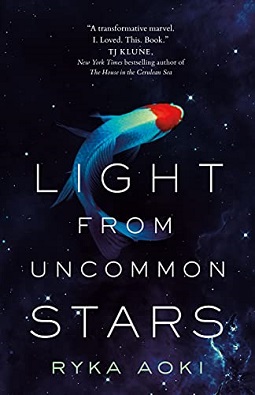
Our heroine is Katrina Nguyen, a trans teenager and gifted violinist. Legendary violin instructor Shizuka Satomi hears Katrina playing in a park and decides to take her on as a student so she can complete her Faustian bargain with the demon Tremon Philippe and deliver Katrina’s soul to Hell. Alien refugee and spaceship captain Lan Tran has fled to Earth with her family and fallen in love with Shizuka after she visits the donut shop Tran runs as a cover operation for constructing a stargate.

Catch all that?

There is a lot going on in Light From Uncommon Stars, and while it’s at times a fun and dizzying combination of science fiction and demons from Hell and classical music, sometimes it’s a bit too much. Memories and flashbacks appear out of nowhere without adding anything to the story or its characters. Shizuka’s grand declamations and philosophical reflections about the power of musical performance are at once too long and too shallow to really ring true for me. All of this crowds out more interesting material for me, like Katrina’s genuinely insightful and touching reflection on gender identity through the metaphor of Bartok’s Sonata for Solo Violin.

Nor does Aoki flinch from at least gesturing at the more traumatic events of Katrina’s previous life, which don’t always blend well with the wacky feel-good sci-fi hijinks. There were moments where it hit something like anti-lagom (mogal?), exactly wrong instead of exactly right: what should be goofy space shit feels a bit out of place compared to what just happened in the last chapter; betrayal that would take a lot of time and therapy to work through in the real world is brushed aside almost immediately to get our wacky plot on the road.

But there are violins.

According to her author bio, Aoki is also a composer. This is hardly surprising given the countless musical references, including several to—of course—Paganini. (And yet, apparently Tartini’s “Devil’s Trill Sonata” was too on the nose for Aoki to use here? Missed opportunity, if you ask me.) I don’t know if Aoki is also a violinist, but whether it was lived experience or impeccable research, many of the violin-specific asides landed for me in an almost visceral way; the same embodied memory as when I hear a piece I performed in orchestra. “Does she need some tape on her fingerboard?” is one withering remark from the antagonist about Katrina’s inexpertise that made me cringe in shame: that controversial, or at least pedestrian, method was how I had been taught. Crappy rosin in plastic cases. Tuning forks. The way it feels to slide a wire mute over the bridge. Viola jokes. (Or, well, one viola joke. Which was mostly implied.) All of that was an absolute delight, to the point where I began to get a bit irritated when the book wasn’t talking about music. (Or food. Lots of food in this book. Her bio doesn’t mention it but I bet Aoki would call herself a foodie.)

Violins, however, are not enough. To put it bluntly, there was a lot in Light From Uncommon Stars that was simply not written for me. I don’t mean that because of the subject matter beyond my own lived experience (I’m not Asian, I’m not trans), but rather on a more “philosophy of reading” level.

Any conflict not immediately related to the relationships between Shizuka, Katrina, and Tran inevitably comes to a pat conclusion within a page or two. Minor villains are either destroyed immediately after their appearance (a racist storeowner drops dead of a heart attack half an hour after he disses Katrina’s violin; the emcee of a talent showcase who makes transphobic jokes at Katrina’s expense suffers a housefire), disappear entirely from the narrative (Katrina’s awful roommates), or are declared irredeemably toxic by Implied Word of God and summarily consigned by Katrina to the memory hole with no mourning or regret (Katrina’s parents). All of these had the potential to be the site of really thoughtful consideration and nuanced storytelling, but Aoki just sidesteps them, which then inspires the question of why include those conflicts or characters in the first place.

Everything neat and tidy, warm fuzzies and bear hugs for everybody.

I get why people want that in a book. I get in that mood sometimes, too. But I wasn’t in that mood when I picked up Light From Uncommon Stars so I had a hard time enjoying the book on those terms. Settling back into my violinist body, though? Even for just a couple of hours? That’s what I’m here for.
The Power of the Dog

While I think it’s important to try to chip away at a TBR, either through actually reading the books on it or constantly refining it and winnowing it down, I think it’s also important to stay open to truly random, out of left field suggestions.

The Power of the Dog was one such left field book—a coworker mentioned over beers that our mutual friend had given the book a strong recommendation but that he couldn’t stand it himself.

“You love yourself too much, book,” was his exact complaint.

But, same as with L’Élégance du hérisson or Pappan och havet, I get curious about the books that people I know are really enthusiastic about. The library had a copy and I had a trip up to the family farm over the weekend so plenty of time for reading.

Brothers Phil and George run a cattle ranch out west, after the retirement of their Boston born-and-bred parents to Salt Lake City. Phil and George are a study in contrasts; briefly put, Phil is something of a bully while George is amiable and softspoken. Their usual routine is thrown into disarray when George marries the widow Rose Gordon and brings her back to the ranch. Phil immediately writes Rose off as an opportunistic gold-digger, engaging in a campaign of psychological terrorism that drives her to drink and only ends with the arrival of Rose’s son from her previous marriage.

I’m not sure why I’d never heard of The Power of the Dog, or even why I didn’t know anything about Thomas Savage before now. At any rate, you can’t know what you don’t know (the “unknown unknowns”), which is why I make room for those left field, happenstance book recommendations. This was never one I would have picked on its own merits, given its grim subject matter. Even the first page is, frankly, a bit off-putting with its depiction of Phil castrating a calf. But sometimes it’s worth it to push through the discomfort and try something out of your usual habits, and so it was here—Savage’s prose is masterful, economical yet no less rich and nuanced in its expression. Assigning just a single chapter for close reading (here I’m thinking of the second chapter, the story of Rose’s first marriage) would be a great piece of instruction for any writing course.

This unexpected appreciation is why I’m deeply skeptical about, and resistant to, any algorithm-based attempt to recommend books to me. They’ll never bring the same kind of out-of-the-blue suggestion. True, sometimes your friends have kind of crappy taste (no greater betrayal in my reading life than when people whose taste I trusted unironically recommended A Song of Ice and Fire to me), but sometimes they break your gestalt and introduce you to something that sticks with you.

The Seep

Now we’re out of my non-English vacation reading and back into English territory with The Seep, the Austin Feminist Sci Fi Book Club’s selection for October.

Straight off, I really liked The Seep. The only reason I didn’t finish it in one marathon session was because I started reading it in the middle of the night and exhaustion eventually overtook me. To get into slightly more detail, The Seep uses the framework of first-contact and utopia genres to examine grief, how it feels to be left behind by seismic shifts in society, and which struggles are worth having. It’s also very queer, very trippy, and very short: the perfect book for getting out of a reading slump.

Perfect, no notes.

Sisters of the Vast Black

Sisters of the Vast Black was a long-time suggestion from one member of the Austin Feminist Sci-Fi Club and it finally made it to the agenda for our July meeting last Sunday.

Sisters of the Vast Black cover art
Image courtesy Tor

Science fiction is usually pretty critical of religion, especially contemporary established religions like Roman Catholicism, so it’s interesting to see a book take it seriously. Not so much for its cosmology or morality, but for the importance it plays in people’s lives, the good it can inspire them to do, and the soft power it can wield in the name of international (or in this case, interstellar) relations and colonization.

Sisters follows a small spaceship of nuns who find themselves caught up in political intrigue, with a potent biological weapon (and its cure) at stake. Also, their ship is a giant sentient slug who has suddenly imprinted on a mate and needs to change course drastically. And because they’re nuns, of course there’s at least one crisis of faith and a character on the run from a very sinister past.

This was a fun read because the world was so creative and rife with interesting thought experiments, but in the end there were a few too many ideas crammed into the space of one novella. (Rather mentions in her acknowledgments that this started as a short story, which must have been very crowded indeed!) A longer book, or fewer plot threads, would have allowed Rather to give each idea the consideration it deserves and to tie everything together a bit more seamlessly. Maybe the sequel will do just that.

A Desolation Called Peace

This was another pick for the Austin Feminist Sci Fi Book Club, one of the few times we decided on a sequel. I touched on the first book, A Memory Called Empire, in my most recent GoodReads Roundup post. I wish I’d found the time to write a more in-depth review, but so it goes.

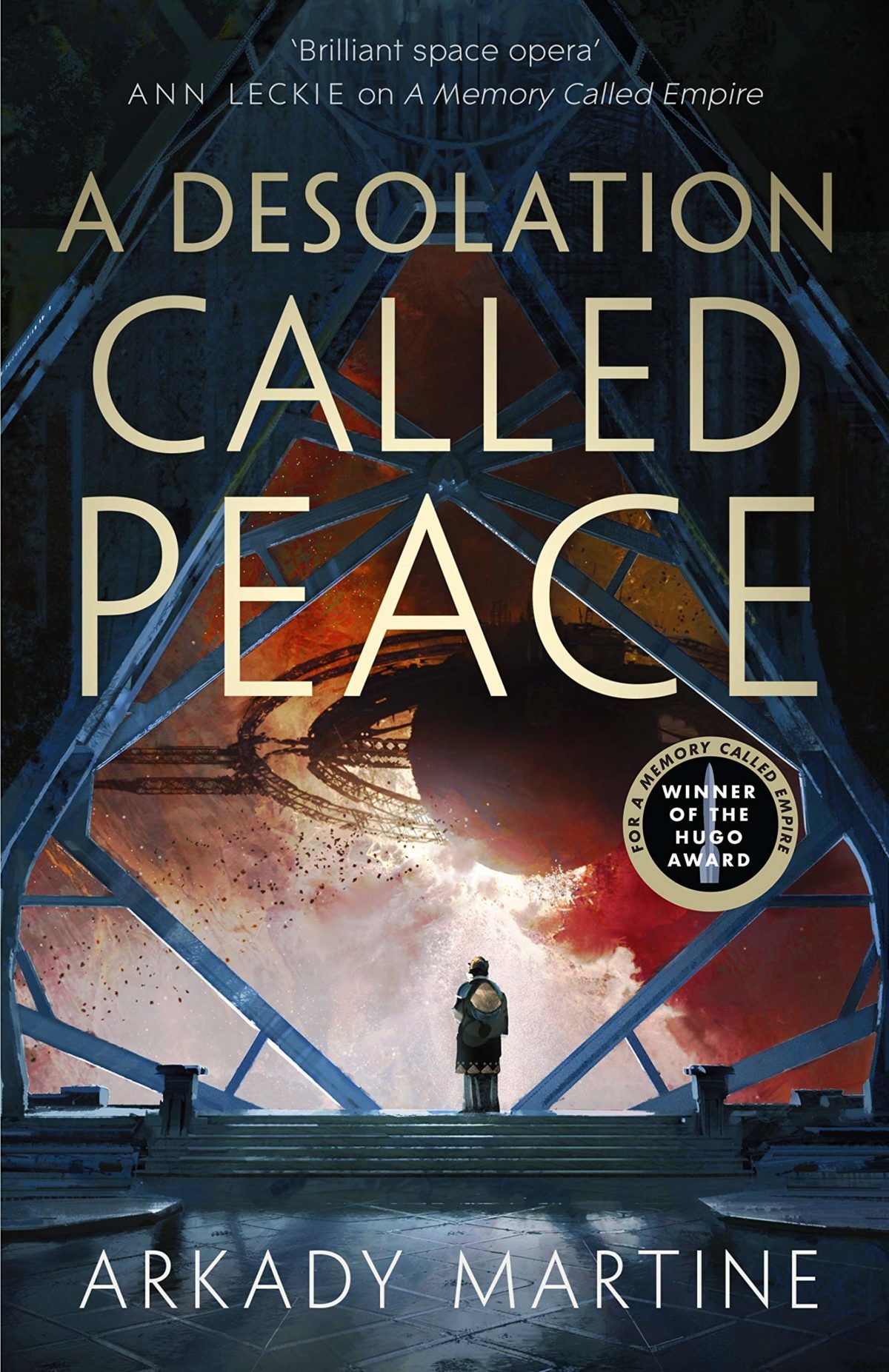
Cover of A Desolation Called Peace
Image courtesy Tor

Desolation follows fast on the heels of  MemoryVery fast. Memory focused on intrigue and the politics of empire and national sovereignty; Desolation takes that conflict and then throws it into a first contact scenario. Considering how much of a plot point the alien threat ended up being in Memory, part of me suspects that they started out as one single volume. If this is indeed the case, then I think the surgical separation went well. Memory had a satisfying, clearly demarcated ending. I would have been perfectly satisfied if I never got around to reading Desolation.

But I still loved A Desolation Called Peace.

Desolation takes our ambassador Mahit, freshly returned from the events of Memory, and throws her into acting as a negotiator and xenolinguist alongside her former cultural liaison, friend, and maybe-lover. The alien threat, meanwhile, is a good ol’ fashioned hivemind with an incomprehensible spoken language so hideous it induces vomiting. As if that weren’t enough, tensions are high at Mahit’s home station and she might not be welcome back. Like Memory, there is still plenty of casual bisexuality, intrigue, and lesbians.

Martine left herself an opening in the end of Desolation. Several openings. Maybe that’s job security on her part, or a cash grab on the part of her publisher. I choose to see them as a gift to the reader. Sometimes the vast imaginary potential of a story is better than any follow up.

The Space Between Worlds

I normally don’t discuss covers much, but this time I will.

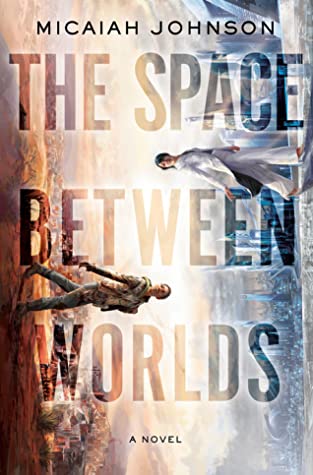
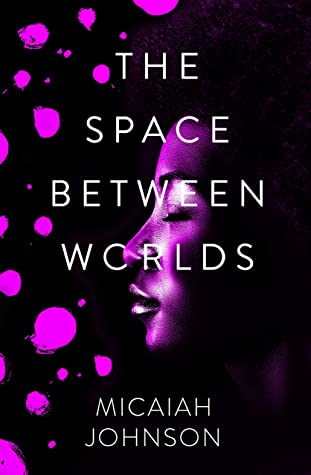
The anglophone books available to me are more often than not UK editions.  Sometimes there’s no difference from the US covers, sometimes there’s a huge difference, but never before have I encountered such a mood whiplash between the two.

US edition of The Space Between Worlds by Micaiah Johnson
US cover, courtesy Crown

Going strictly by the cover, I would assume that we were looking at a fluffy romantic comedy in a sci-fi setting. Either that or a parallel lives kind of story, similar to My Real Children but more light-hearted. Compare that with the UK edition:

UK edition of The Space Between Worlds by Micaiah Johnson
UK cover, courtesy Hodder & Stoughton

The latter more accurately encapsulates the mood of the book for me. I’m not sure what the thinking was behind the US cover, but I have a feeling that it’s probably led to a lot of disappointed readers. Is there fluffy romantic comedy hijinks? Not really! Is there a lot of grappling with the unknown and with morally repellent choices? Yes!

Is there a fair chunk of domestic violence? Also yes.

There is a lot going on in this multiverse story and my brain isn’t really built to handle those kinds of ins and outs. I’ve seen The Big Lebowski I don’t know how many times at this point, and I still can’t string together the chain of events surrounding Bunny’s disappearance, the ransom note, and her reappearance without sitting down and drawing a lot of diagrams and timelines. And that’s a story where the intrigue is just the background plot for brilliantly executed scenes and snippets of dialogue—in The Space Between Worlds the intrigue is basically the entire story.

Guess I need to adhere to a stricter drug regimen to keep my mind even more limber.

Getting back to The Space Between Worlds, all of this is potentially a Me problem and not a Book problem. In addition to my troubled relationship with intrigue, I also took a break from the book for almost a whole week, which couldn’t have helped. Keeping track of the different multiverse versions of characters wasn’t necessarily the hard part, but keeping track of all the different Earths and their politics was a lost cause for my addled brain. Earth 0 is the prime, principal Earth on which the bulk of the intrigue plays out, but events on Earths 22 and 175 are also important. Not to mention I think there’s a third Earth that our traverser protagonist Cara visits, but I don’t think it had much to do with the actual plot.

Likewise there are some world-building elements that were not really laid out cleanly for my addled brain, or that were introduced way too late in the story, or that maybe I just happened to skim over. Unfortunately those elements are kind of plot-essential, so from a technical standpoint I wish they had been made clearer earlier on in the story. (Assuming that I just didn’t miss them, which I totally might have!)

But I was able to overlook all of that because I could see that the point for Johnson wasn’t “wow multiverses sure are cool.” Instead, it was more “how would multiverse traveling get integrated into the world as we experience today” and “how can the idea of parallel lives and parallel selves be used as a metaphor for Real Life Stuff,” and I was along for that ride. It seems, judging by other reviews, that some people weren’t along for that ride. And that’s okay! But since one of my own paradigms for years has been the idea of alternate universe versions of myself, Johnson’s take on the multiverse was a lot of fun for me.

Into the Drowning Deep

“If you don’t have anything nice to say, don’t say anything at all.”

Cover of Into the Drowning Deep by Seanan Maguire, writing as Mira Grant.
Image courtesy Orbit Books

So I won’t be saying anything at all about Mira Grant’s Into the Drowning Deep, except that the quality of writing on display in this book makes her childish Twitter tirade in 2017 about the awful (“awful”) job her copy editor did even more cringe-inducing.

Shoutout to Storygraph, now my preferred choice over GoodReads, for allowing me to give a full-on 0-star review.