Review: Karen Memory

I mentioned having reading to do for Feminist Sci-Fi Book Club during my vacation in Austin, and how I finally tackled The Dispossessed maybe a decade after I first tried to read it. The other book on the docket for book club was Elizabeth Bear’s Karen Memory. I finished it in July, but you’re reading this in August, after feminist science fiction book club, because book club gets first dibs on my thoughts!

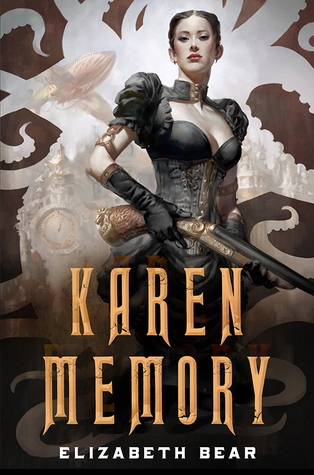
Cover of Elizabeth Bear's "Karen Memory."
Image courtesy Tor

Author: Elizabeth Bear

My GoodReads rating: 3 stars

Average GoodReads rating: 3.73 stars

Language scaling: C2

Plot summary: In a nutshell, Karen Memory is a steampunk Wild West version of Jack the Ripper set in the Pacific Northwest, with international espionage and intrigue thrown in for good measure.

Recommended audience: Steampunk fans

In-depth thoughts: The back of the book features the same summary I just shared above, more or less, and I habitually re-read the backs of books as I read, and even still I was waiting for this to turn into a feminist steampunk version of “Johnny Mnemonic.” Should I have expected that? Obviously not. Was I letting myself get tripped up by the title? Yes, probably. Still, I have to admit to being just slightly disappointed in the book not delivering what I had promised myself it would be.

Elizabeth Bear’s writing is fantastic. Karen has a distinct voice that’s just a lot of fun to read, and the book is worth it for that. This is the first book I’ve read by Bear and I’ll have to find more in the future. But there were a few things that tripped me up, which is why I didn’t give it a higher rating. (I suppose it’s nitpicking to expect the correct dates on radium watch dial painting in a novel that is very clearly a fantastical alternate universe, but it’s my job to be a nitpicker, so I’ll let it bother me.)

A more salient point for EFL readers is that while Bear’s writing and Karen’s voice are distinctive and stylistic, they may be too stylistic for many EFL readers. Karen’s voice employs non-standard grammar and slightly antiquated vocabulary that I can see as being confusing or off-putting (hence such a high language grading). But if you’re a very committed steampunk fan, it’s well worth the effort it might take to adjust to the language.

Book Review: Kris

It would be hypocritical of me to encourage my students to read novels in English, and then not do the same in Swedish. I actually think it’s a good exercise for EFL teachers, as well: choose a foreign language you can reasonably read and understand and make ongoing attempts to read in that language. It’s important to remember how frustrating a foreign language can be, at times, and help you empathize with your students and be a better teacher.

This is going to be a shorter review than usual, for what I hope are obvious reasons (i.e. novels in Swedish won’t really help anyone learn English). But I like to keep as complete a public record of my reading as possible, so I still want to make note of it here.


Author: Karin Boye

My GoodReads rating: 4 stars

Average GoodReads rating: 3.66 stars

Language scaling: N/A

Plot summary: Malin Forst is a seminary student in the period after the first World War. Romantic feelings for female classmate, Siv, paired with with the free-floating uncertainty in post-World War I Europe lead Malin to a crisis of faith and subsequent nervous breakdown, after which she has to reevaluate her life and reassess her own moral code.

Recommended audience: Fans of queer literature; fans of modernist literature.

In-depth thoughts: I was already familiar with Boye’s other novel, Kallocain, which I actually read in English when I was an exchange student at Stockholms universitet in 2007. I’m not sure if Kris is available in English, but Kallocain definitely is and I would recommend that for EFL students who enjoy science fiction. But Kris is much different; it’s much more modernist and experimental than the relatively straightforward and plot-driven Kallocain. Boye explores Malin Forst’s breakdown through inner monologues and dialogues, conversations among notable historical figures and personified abstract concepts, as well as straightforward narration. The novel is episodic, which is great when you’re reading in a foreign language and have trouble maintaining focus for long stretches. (I love Par Lagerkvist, but I also think he could use chapter breaks and now and then.)

Boye is primarily known as a poet, and that shows in the way she uses language and imagery throughout Kris. It only took me so long to finish Kris because I was reading three or four book simultaneously, on top of being busy. It’s a great option if you need something to read for SFI, SAS, or AKSVA.