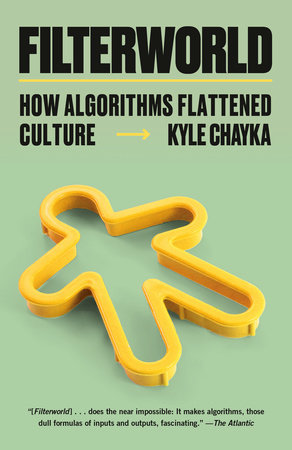
If I find myself somewhere bored and bereft of a book, I like to dig back through my TBR and find something I can get as an ebook from one of my libraries. This is how I came to be sitting in my favorite neighborhood haunt, drinking a beer and reading Kyle Chayka’s Filterworld. In brief, Filterworld is a snappy history of how recommender algorithms have come to shape our Internet, and our broader cultural, experience. It covers a lot of the same territory as Chokepoint Capitalism, though with less pissed-off creator-side rage in favor of a more anxious user-side perspective. “Do I actually like the things I like?” is Chayka’s recurring question.
Chayka’s proposed solution to The Algorithms, to the extent it is a workable solution (and to the extent he even calls it a solution), is to slow down our focus:
If there is a simple answer to breaking down Filterworld, then it might be something like a version of the slow food movement, as it was popularized in the 1990s, but for culture…We need to bring that same understanding of sustainability and specificity to the way that we consume and support culture online, too. Resistance to algorithmic frictionless requires an act of willpower, a choice to move through the world in a different way. It doesn’t have to be a dramatic one.
He then gives the example of visiting a local cafe that he’s always passed but never visited because he didn’t find it appealing; in his own words, it wasn’t “Instagrammable”:
I felt both bemused and sad that this was a rare experience, something like visiting a museum. Our phones and feeds absorb so much of our attention and dominate so many of our preferences that stepping out of their conveniently predetermined paths and choosing an experience not immediately engaging feels somewhat radical. This applies to fashion choices as well as food, which television shows we watch, which books we read, which furniture we buy, where we travel. If we shift our priorities away from the space of algorithmic digital platforms and once more to the physical world, in which everything is not instantly evaluated in terms of engagement, we might find ourselves building not only better culture but better communities, relationships, and politics as well.
I’m cutting to the chase partly because that’s what struck me most about the book. Chayka is describing an experience that I know a lot of people have, and yet that I don’t (not entirely). I only begrudgingly acquired a Twitter as a means of freelance self-promotion, but never became hooked on the platform and stopped Tweeting as soon as I no longer needed to promote myself. I’ve never used Spotify as my primary music library or my means of discovering new music. My partner periodically subscribes to Netflix, and we’ve been known to occasionally bingewatch particular series or short docuseries, but the last one was An American Conspiracy: The Octopus Murders back in 2024. I never rely on Yelp or similar to find cafes, or online travel agencies to plan my international vacations. I post to Instagram but am not really invested in comments or hearts or followers. Only posts, no reels, maybe the occasional story. Admittedly, I can get sucked into watching a comedy reel about Philly if the feed finds me in a moment of weakness, but I have no desire to follow those accounts. I do not, and will never, have TikTok. The only thing I will cop to is a YouTube history that is probably wildly schizophrenic, since I use it for background music while I’m working and my tastes run from symphonic to techno to “this song popped into my head when I woke up and now I need to listen to it on repeat all morning or I won’t get any work done.”* And while I never sign into my Google account on either of my work computers, I’m sure that nonetheless the algos have managed to connect my legal person to those dozens, possibly hundred or so plays of “Takin’ Care of Business” that one day last February.
Every time Chayka observed his algorithmic behavior or reactions in a state of what I’d call “vaguely befuddled despair,” I couldn’t help but think, “But you could just…not.” So in the end, when his solution is to, indeed, “just…not,” I didn’t find it much of a revelation.
Chayka has an art history background, so it’s no surprise that what I found most compelling (and what he spends the most time on) is how once again the medium has shaped the message: “BookTok” and the proliferation of autofiction in literary bestsellers, the lack of key changes in pop music, art exhibits so specifically designed for Instagram selfies that they become meaningless otherwise. Chokepoint Capitalism outlines the structural inequities of such recommender systems, but Filterworld also reminds us that they’re also having direct influence on the culture itself—one that exists for all of us, regardless of whether any given one of us subscribes to Spotify, Netflix, etc.
It with immense satisfaction, then, that I can wrap up this post by pointing out that the algorithms weren’t the ones to bring me to this book. A guest on a podcast recommended it; that podcast in turn had been recommended to me by a friend. It was human connections all the way through, made specifically and deliberately by people to make a point. The podcast guest was on to talk about social media generally, and felt it relevant to mention; my friend recommended the podcast because the show often touches on things that he knew we both were interested in. I think Chayka would be happy to hear that.
* Here I have to say that I’m grateful to Chayka for highlighting the streaming service Idagio as a better alternative than Spotify for classical music. The platform detects and counts plays differently, using calculations more appropriate for longer classical pieces than three-minute pop hits, and recommendations are picked by human experts with care and deliberation rather than statistically driven recommenders. I might go ahead and subscribe once I’m back from vacation, since this post is going live while I’m at a cabin in Kiruna.