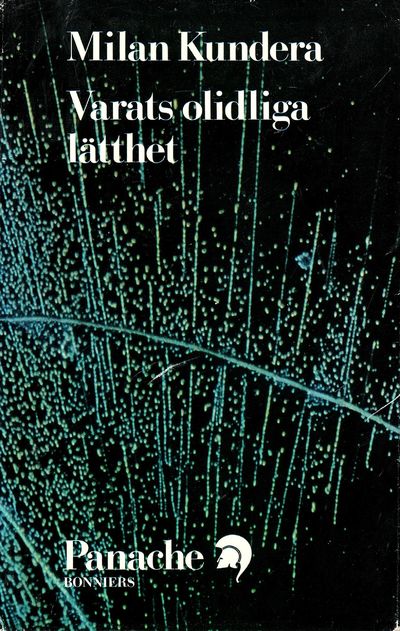
I was particularly interested in the International WhatsApp Book Club selection for August, The Unbearable Lightness of Being (which I read in Swedish: Varats olidliga lätthet), because it’s a long-time favorite of my Bloomsday book buddy and in all the years I’ve known him he’s proven to have impeccable taste. Once again, he didn’t let me down!
Lätthet follows four interconnected people around the time of the Prague Spring and some years beyond: Tomas, his wife Tereza, his friend and lover Sabine, and Sabine’s lover Franz. The timeline is slightly disjointed: we learn about a character’s death in one section, and then the next section will circle back to the same character several years before and follow what happened to them up until their death. All of this is held together with the glue of intense philosophizing, either on the part of the perspective character or of a nameless and unconnected first-person narrator who we can only assume is the author and therefore Milan Kundera himself interjecting. (As opposed to the perspective-shifting in Lol V. Stein, where the first-person narrator is most decidedly not Duras or any otherworldly author.)
The story and the characters exist solely as case studies or tools for Kundera to engage in philosophizing, but he still manages to capture distinct and nuanced personalities rather than flat stereotypes. There’s nothing more exhausting in a book than a blowhard author using characters as puppets in little morality plays; perhaps the difference between Kundera and a blowhard is that Kundera raises and debates questions he doesn’t seem to have an answer to, while a blowhard almost by definition has decided they have all the answers.
The Swedish translation was from Ulla Bruncrona, and I have nothing to add about the translation itself. Mostly I want to remark that out of nowhere J. M. G. Le Clézio has decided to haunt me. I’d never heard of him until a book friend mentioned him last week and it’s been a bit of Baader-Meinhof phenomenon since. The day after that conversation, I finally got around to starting a French novel I had picked up weeks ago from our neighborhood buy-nothing group, only to be greeted with an epigraph from Le Clézio, and now in writing this up, I’ve learned that Ulla Bruncrona is his primary Swedish translator. Well then, universe. I’ll give Le Clézio priority in my TBR.