Surfing With Sartre: An Aquatic Inquiry Into a Life of Meaning

I found Surfing With Sartre during a bookstore meander back in the spring. When it was still there in October, I took it as a sign from the book gods and took it home with me. Oh, there’s nothing like an old-fashioned bookstore browse! Which is probably why Amazon is opening up brick-and-mortar stores.
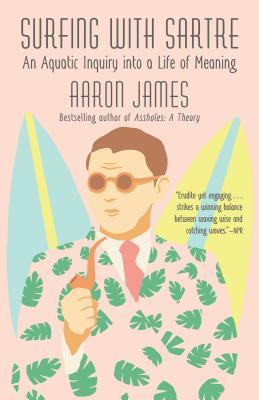
Surfing With Sartre, Aaron James
Image courtesy Anchor Books

Author: Aaron James

My GoodReads rating: 3 stars

Average GoodReads rating: 3.55 stars

Language scaling: B2 (except the occasional quotes from other, older, deader philosophers or surfing terminology)

Summary: Surfing as a framework for philosophy: how does the physical act of surfing embody philosophical concepts? Do surfers have a paradigm with sound philosophical grounding?

Recommended audience: Surfers, philosophers, socialists

In-depth thoughts: There’s been a tradition of _____________ and Philosophy books: The Matrix and Philosophy, The Simpsons and Philosophy, The Beatles and Philosophy, etc. etc. and frankly I’ve found them dubious, with the philosophical connections to mindless pop culture tenuous at best. But Aaron James is more thoughtful than that, and even though he could have called the book Surfing and Philosophy and thrown it on the pile, this is a much more thorough examination, and with much better grounding.

Sartre was apparently into water skiing. Who knew? (Now you do!)

James has a knack for simple, elegant explanations of knotty philosophical concepts. His writing is conversational but steers clear of condescension. My own quibbles are of the Not For Me variety: leaning more on the surfing framework more than I was expecting (so much surfing terminology throughout that is defined much less clearly than the philosophical terminology) and a needless aversion to singular “they” (“he or she” is so damn clunky!). I’m mostly on board with James’s philosophy, so I don’t have any arguments against his thesis, though I did note the occasional “I’m a white guy doing OK for myself” blind spot and what I would consider contradictions. For example, it’s a bit odd for someone who’s genuinely concerned about climate change and the state of the planet to be so glib about the many long-haul flights they take just for the sake of a hobby, and even to encourage others to do the same. There’s a tension here that I don’t think James really resolves.

That unresolved tension, and the fact that reading the book was essentially preaching to the converted, is why I didn’t rate the book higher. James is an agreeable and lucid writer, so I can imagine in the hands of another person, this might lead to a major paradigm shift. No regrets, though: the book is en route (hopefully now in the hands of?) one of my philosophy nerd friends, so I’m glad I coughed up the money for it.

Currently Reading: Godel, Escher, Bach: An Eternal Golden Braid

Because one doorstopper isn’t enough, I decided that this was also going to be the year that I read Godel, Escher, Bach: An Eternal Golden Braid. According to GoodReads, it’s been on my “to read” list for ten years.

The cover of Godel, Escher, Bach: An Eternal Golden Braid
Image courtesy Basic Books

I took a philosophy of mathematics course in undergraduate, which involved a lot of set theory and discussions about infinity and  things I didn’t quite grasp. The only question I could meaningfully wrap my head around was whether or not numbers are real—I spent the rest of the seminar feeling a little outclassed and outsmarted.

One of the readings for that class was an extract from Godel, Escher, Bach, the little thought experiment with the MIU system. I liked that well enough, and I suspect that’s why I put the book on my to-read list (the timing would be about right). It stayed on there because once in a while, people would recommend it to me. And now I’m finally reading it because I’m making a concerted effort clear out my 235-title “to read” list before I embark on another “TIME Top 100 Novels” style reading project.

Current thoughts: this could have used some serious editing.

Having worked on dense, academic texts and abstract subject matter myself, I recognize that it’s a humbling project to edit something you’re not entirely sure you understand. So when I say “serious editing,” I mean something more like peer review: someone else in the know going through the material and suggesting revisions, deletions, and additions.

I don’t mind all of the dialogues, or the Escher illustrations. But sometimes an author goes on a really deep dive into their passion projects and it only ends up being to the detriment of their book. I say this as someone whose favorite parts of Infinite Jest were the loving descriptions of tennis; I have a high tolerance for people’s enthusiasm for things I don’t know or particularly care about.

The difference between Godel, Escher, Bach and Infinite Jest is that Godel, Escher, Bach is very desperately trying to teach and communicate something, whereas at the end of the day, Infinite Jest is just (“just”) a story. There are countless little asides and meanderings that don’t seem to support Hofstadter’s thesis, or clarify it, but are rather amusing consequences thereof.

As if to underline my point, the 20th Anniversary Edition (the one I’m reading) includes a new preface by the author which could be summarized “No one got my point!” If that’s the case, Hofstadter, I don’t think the fault lies with the readership. I assume it won a Pulitzer Prize because it was big and heavy and was about an issue of the moment (artificial intelligence).

I’m 520 pages in and I’m a little disappointed so far, as what prompted me to pick this up was an article Hofstadter recently published about machine translation (translated into Swedish, funnily enough). Nothing that was interesting in that article has turned up in Godel, Escher, Bach. It seems that after all these years, Hofstadter has walked back his estimations of what artificial intelligence can do, or has at least revised it for more nuance. Or maybe I’m just more interested in what he has to say about machine translation than about machine intelligence.

The Internet seems to agree that his follow-up book, I Am A Strange Loop, does a better job of more clearly and concisely explaining the points Hofstadter mentions in Godel, Escher, Bach, so perhaps I’ll add that one to the “to read” list after this one is done.

So much for whittling down said “to read” list….

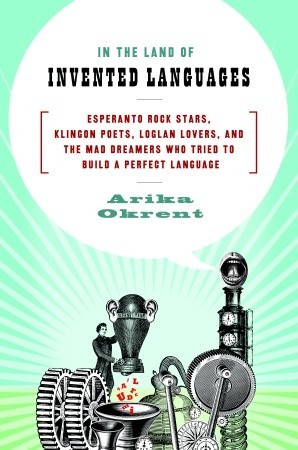
In the Land of Invented Languages: Esperanto Rock Stars, Klingon Poets, Loglan Lovers, and the Mad Dreamers Who Tried to Build a Perfect Language

With In the Land of Invented Languages, Austin, TX’s premiere feminist sci-fi book club took a lefthand turn into nonfiction for the month of September. Lucky for me! As a language professional, this sort of thing is right up my alley.

Cover of The Land of Invented Languages

Author: Arika Okrent

My GoodReads rating: 4 stars

Average GoodReads rating: 4.08 stars

Language scaling: B2

Summary: Okrent travels the world and interviews several experts and nerds to shed light on constructed languages.

Recommended audience: Anyone interested in popular linguistics; aspiring fantasy or science fiction writers who really want to commit to the bit

In-depth thoughts: I actually read In the Land of Invented Languages over a month ago, and somehow never got around to writing about it until now, which makes writing any useful review rather difficult. All I can say is that I enjoyed it a lot. This isn’t any dense, academic paper; it’s a series of relatively short, surface-level essays on a variety of constructed languages. My favorites included the one about Esperanto (I was inspired enough to actually look up Esperanto groups and Meetups in Stockholm!), Bliss symbols, and of course the background into Klingon; the actual assigned reading for book club was the essay on a woman-centered language entitled (if I recall correctly) “to menstruate joyfully.”

What’s still clear, even now, is that creating a new language—at least one intended to be used in the real world—is an admirable endeavor, based in optimism, idealism, and no small amount of compassion. Every language that failed to take off broke my heart a little, even though the logical conclusion of their success would mean a different line of work for me.  Constructed languages also raise interesting questions of intellectual property and usage. No one can own a natural language, but what about a constructed one? Does it belong to its creator(s) or to the people who speak it?

Okrent is writing for a popular audience, so there isn’t much in terms of specialized vocabulary or ultra-dense academic writing. In the Land of Invented Languages is a fun and breezy ready for language nerds of every mother tongue.

Currently Reading: Ulysses

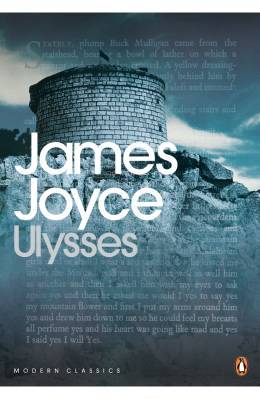
Ulysses Modern Classics edition cover
Image courtesy Penguin

It’s been my habit for a long, long while—even before I set up shop here on my “professional” site—to have book reviews written and ready to go on my blog on Wednesdays. This generally works out with few interruptions, as I average around 48 books a year. But since I’m juggling five books simultaneously (and two of them 600+ page doorstoppers), that means there’s going to be a bottleneck of reviews until I start finishing them all. Hence a stopgap measure: writing about a book I haven’t finished reading yet.

This model of book blogging also comes with a few benefits: I’m a social reader who likes to talk about what I’m reading, even if it’s a one-sided conversation with the faceless void of the Internet. And frankly, my standard review template is kind of inadequate for such overwhelming tomes, so these “thoughts along the way” can stand in for a final review post. Also, publicly logging my progress with the doorstoppers is a way to hold myself accountable for reading them. (However, psychology suggests that publicly displaying or discussing your goals in this manner has the opposite of the intended effect, so who’s to say?)

Doorstopper #1 is Ulysses, which I’m reading both because I’ve never read it and because another book friend wants to do a Bloomsday 2019 visit to Dublin. (I proposed a buddy read but I think I’m the only buddy actually reading it, but maybe he’s simply reading it on the sly and not mentioning it to me!) At this point I’m 376 pages in, or about four months in to my ten-month plan.

The first time I’d heard anything about Ulysses was when I was maybe 12 or 13 years old, from a slightly-older teenager with whom I might or might not have been slightly enamored. He referred to it as “the worst book ever written,” so that’s the epithet I’ve associated with the book from my childhood, for better or for worse. I wish I remembered anything else about this childhood Internet friend, except that he once sent me a poem he wrote, without using any verbs, about the ampersand. I wonder what you’re up to today, Jay.

Anyway, on to Ulysses.

Current thoughts: Maybe I should have started with Portrait of the Artist as a Young Man instead. But at least it isn’t Finnegans Wake.

I genuinely enjoyed the first two sections, but there is possibly such a thing as too much interiority and too much wordplay and too many references. I wonder how much easier it would be to track if I were an Irish contemporary reading this rather than someone removed by almost 100 years and however many miles. (The years, I suspect, make a bigger difference than the miles.)

At this point I mostly find myself nostalgic for re-reading Mrs Dalloway rather than actually enjoying the book in front of me, which is never a good sign.

I’ve been enjoying Frank Delaney’s Re:Joyce podcast, but my listening lags far behind my reading and so I don’t know if I’ve yet outstripped the available episodes. I appreciate Delaney’s little five-minute lectures on the minutiae I wouldn’t otherwise catch, but despite all his enthusiasm I can’t find the same charm and fascination in the text that he does. I suspect this is how most people feel when I get sidetracked in a conversation and start talking about caves or Korea or grammar.

The Internet of Garbage

One of the best decisions I ever made was to subscribe to LitHub. A recent newsletter tipped me off to the fact that The Verge was making The Internet of Garbage available for free, and minutes later it was on my Kindle app.

Author: Sarah Jeong

My GoodReads rating: 4 stars

Average GoodReads rating: 4.16 stars

Language scaling: B2+

Summary: A brief history of contemporary Internet hate and death threat campaigns, as well as suggestions to mitigate them.

Recommended audience: Anyone who uses the Internet but doesn’t know what “doxxing” means

In-depth thoughts: Much of what Jeong reports on here isn’t new to me, but then again I’m a digital native with one eye constantly on the Internet hellscape. Many people aren’t, though, and so when cases of online harassment boil over to the point where traditional media outlets begin reporting on them, there is inevitably something lost in the explanation. The Internet of Garbage is an excellent 101 primer on the subject. And therein is my only criticism: it doesn’t go beyond the 101 level. But since the reason The Verge put out a free interim edition of the book is in anticipation of a forthcoming expanded edition; perhaps that new edition will have a bit more meat to it.

But again, it’s easy for me to say that because I’ve kept apprised of Internet hate campaigns from the beginning. For other people, this is exactly what they need. For EFL readers, the language is crisp and direct, with the most potentially confusing terms helpfully defined.

Ancillary Justice

Earlier this year it felt like I had a reading dry spell: one mediocre book after another. Feminist science fiction book club to the rescue! Ancillary Justice was the August selection and it reminded me of everything that can go right with good sci-fi.

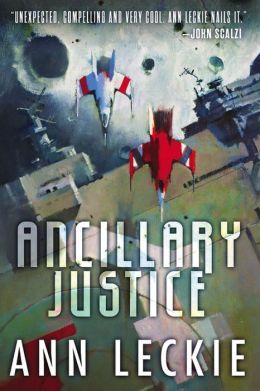
Image courtesy Orbit

Author: Ann Leckie

My GoodReads rating: 5 stars

Average GoodReads rating: 3.98 stars

Language scaling: B2+

Summary: The now-embodied AI of a huge starship travels across the empire they once served to exact revenge on the emperor.

Recommended audience: Sci-fi fans; in particular, fans of Asimov’s Foundation series, who might be interested in another vision of “Roman empire in space”

In-depth thoughts: The great technological marvel of the science fiction empire in question is ancillaries: human bodies used as a extensions of a starship’s AI, something like a miniature Borg collective. Leckie very skillfully navigates this perspective and, more than being a cool gimmick, this splintering of awareness is also an important story element. Leckie’s writing is also polished and economical, with enough details to keep the reader anchored but not so many you become overwhelmed; in a way, it’s exactly how you can imagine a very sophisticated AI would describe and process the world: picking out one or two concrete and salient details out of an input of thousands or even millions, but at the same time failing to make distinctions that humans can sort in an instant. (In this case, the AI has difficulty with all of the different gender markers in the assorted cultures they encounter.)

While the story is full of invented names and languages (always the case in space opera), the clear-cut prose should be relatively easily navigable by high intermediate learners.


Carry On, Jeeves

Back in June I organized a book swap for the Meetup I co-organize, The Stockholm Writing Group. I came away with a bunch of new children’s books for my work library, plus Carry On, Jeeves.

Author: P. G. Wodehouse

My GoodReads rating: 3 stars

Average GoodReads rating: 4.28 stars

Language scaling: C1

Summary: A collection of Jeeves short stories, including “Jeeves Takes Charge,” “The Artistic Career of Corky,” “Jeeves and the Unbidden Guest,” “Jeeves and the Hard-Boiled Egg,” “The Aunt and the Sluggard,” “The Rummy Affair of Old Biffy,” “Without the Option,” “Fixing It For Freddie,” “Clustering Round Young Bingo,” and “Bertie Changes His Mind.”

Recommended audience: Anglophiles

In-depth thoughts: Despite a life-long affinity for British pop culture and humor, Carry On, Jeeves was my first-ever exposure to P. G. Wodehouse. I wasn’t exactly disappointed, but I wasn’t blown away, either. Certainly Wodehouse is a master of the plot, and has an impeccable ear for character voice, but there is an element of “privileged men getting to do whatever they please” that is unappealing in this day and age, at least for me, especially in combination with the rather dated, stereotypical women characters. I can see what makes the stories enduring classics, though, and they’re certainly diverting. I might have also been in a grumpy mood when I read them.

Advanced learners might enjoy Wodehouse’s prose, which is polished and distinctive. I wouldn’t recommend these stories for beginner or intermediate learners, however, who might find the old slang terms too much of a barrier of entry.

Proust and the Squid

My ongoing self-directed professional development in the field of translations sends me deep into the academic and coursebook stacks at Stockholm University, most often within the linguistics section. On my last visit, Proust and the Squid caught my eye—what a title!—and, after just a moment’s hesitation, I added it to my stack.

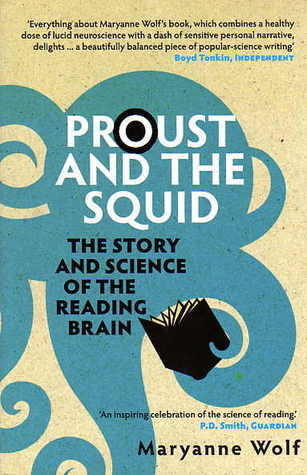
The UK version of Proust and the Squid
Image courtesy Icon Books, Limited

Author: Maryanne Wolf

My GoodReads rating: 5 stars

Average GoodReads rating: 3.8

Language scaling: C1

Summary: Wolf sketches a short history of reading and the written language within a neurological framework, and hypothesizes about the neurological basis for dyslexia and other reading disorders.

Recommended audience: Elementary school teachers; special education teachers; book lovers; dyslexics

In-depth thoughts: I wasn’t expecting Proust and the Squid to be as good as it was, and I went into it expecting to enjoy it. Wolf manages to make complex neuroscience accessible to the layperson.

I debated whether to give this 4 or 5 stars. For anyone who works with young learners, this is a solid 5 stars. Wolf’s approach to typifying reading disorders and pinpointing what seems to be happening in the brain in these situations will no doubt prove useful for teachers, tutors, or parents with dyslexic children. I imagine it would be interesting to special education teachers as well, though maybe much of what Wolf touches on here would be covered in even greater detail over the course of a special education degree. Adult dyslexics might also appreciate understanding the neuro- and physiological foundations of reading and what’s happening in their brains in particular.

For the general public, I would say it’s only 4 stars, only because while the history of reading and the brain is fascinating for me, its immediate relevance to everyday life is more oddity than urgent. Wolf is largely accessible when writing about the hard science, but she tends towards to err on the side of obscurity rather than simplicity. It’s largely for that reason I would consider this a difficult book for English students (unless they were particularly motivated.) I’ll certainly have to read Proust and the Squid a few times to really appreciate it. It’s also been over a decade since the initial publication. I’d love to read an updated edition and see if there have been any new breakthroughs.

2023: A Trilogy

I’m planning on doing a buddy read of Ulysses this year, and much as I love and patronize libraries, some books are impossible to read unless you own them and have access to them at your leisure. (How many times did I try reading a library copy of The Second Sex, for example?) I spent the afternoon in town browsing The English Bookshop, and while I ended up having to special order Ulysses from their Uppsala store, the chance to browse the random selection led to me finding books I wouldn’t have otherwise. 2023: A Trilogy was one of them.

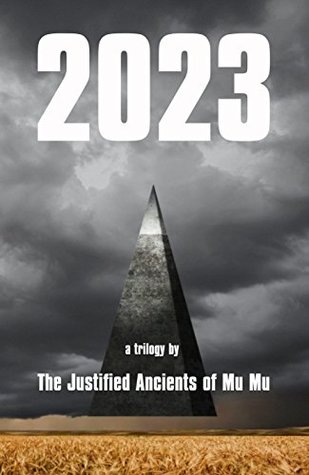
Cover of "2023: A Trilogy" by The Justified Ancients of Mu Mu

Authors: The Justified Ancients of Mumu, aka The Kopyright Liberation Front, aka Bill Drummond and Jimmy Cauty

My GoodReads rating: 3 stars

Average GoodReads rating: 3.67

Language scaling: B2+

Summary: A “found footage” type of story. At the most basic level, the story is a satirical sci fi dystopia/utopia where five corporations benevolently rule the world and a programmer named Winnie Smith might just have solved the problem of immortality.

Recommended audience: Anyone who thought the original Illuminatus! trilogy was too much of a slog, leftover KLF fans, anyone who enjoys meta and self-referential texts, pop music nerds, anyone nostalgic for the 80s and 90s

In-depth thoughts: A boy I had a crush on in high school thought the Illuminatus! trilogy was one of the best books ever written and so I devoted a summer to trying to read it. I made it halfway through and never finished, but it was enough that even years later I can recognize the countercultural significance of things like 23, 17, and fnords.

This is important because Drummond and Cauty have packed 2023 full of Illuminatus!  references (mixed in with the literary and pop music references). If I hadn’t been able to call back to those particular references, I might well have been too lost to appreciate the book.

It’s a fun read if you’re either in the know or thirsty for meta, slightly experimental satirical science fiction. Whether or not this would be a good read for English students depends on how familiar they are with the cultural references in question, and how willing they are to track different narrative levels. The language itself isn’t too difficult, but the allusions and the metanarratives might be too frustrating for some readers.

The Spider King’s Daughter

The June selection for my Facebook book club was The Spider King’s Daughter, the debut novel by Chibundo Onuzo. I went in hoping that it would pull me out of the book slump brought on by RadianceHow I Became A North Korean, Gena/Finn, and the middle grade books I previewed for some of my students. The Facebook book club has the best hit/miss ratio out of all three that I’m in, after all.


Author: Chibundu Onuzo

My GoodReads rating: 3 stars

Average GoodReads rating: 3.42

Language scaling: B2+

Summary: Abike, the daughter of a wealthy (and shady) businessman, encounters “Runner G,” a street hawker with a tragic past, and the two begin a relationship. Things take an unexpected turn when Runner G takes a fresh look at his own history.

Content warning: The book opens up with a gruesome scene of animal cruelty, but everything else afterwards is fairly tame

Recommended audience: Thriller fans; YA fans looking for something a bit grittier; those interested in Nigerian literature

In-depth thoughts: Onuzo is an engaging writer and I hope she continues down that path. (Her second book, Welcome to Lagos, came out last year. Hurrah!) This was engaging at a time when nothing else I was reading could capture my interest and Onuzo deserves a lot of praise just for that.

My favorite parts of the book all involve spoilers. I will say this: what starts as a meet cute adolescent love story takes on an unexpectedly darker tone. Or maybe I should have been expecting that, considering that the book opens with Abike telling us about how her father had her beloved dog deliberately run over.

Most of the reveals were more or less obvious, but the book doesn’t rely on the shock of those reveals for impact. I think, even, Onuzo expects readers to already know the truth from the very beginning. It’s how the characters react to these reveals that’s engaging and unexpected.

The book switches between Abike and Runner G’s perspectives, with Abike’s in italics. Reading extended passages in italics is straining, at best, but Onuzo’s prose (and the short paragraphs) make it much easier than in other books (James Agee’s posthumous A Death in the Family, for example). At the book’s climax, when we switch between Abike’s and Runner G’s perspectives rapidly—at every line, for a short while—this typesetting choice proves very necessary.

Set in Lagos and with secondary characters from poverty classes with little or no education, there is a fair amount of pidgin English and Nigerian slang in the dialogue. Readers will be able to discern meaning from context in most if not all cases, but EFL readers might be a little disoriented at its initial appearance.