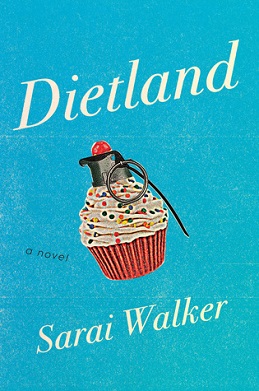
The second part of my Fat Triptych from Christmas 2025 (yes I’m writing this in May 2026) was the splashy and much-lauded Dietland by Sarai Walker.
I had been so excited to read this one back when it was first announced. All of the book blogs I was following at the time loved it and kept comparing it favorably to Fight Club and it just seemed like it would be a really fun and life-affirming read!
It was not.
I wonder if I would have liked it better if I’d read it on first release—when I was a different person, when the world and The Discourse was different as well—or if that wouldn’t have made any difference at all. It left such a disappointing taste in my mouth that I had to immediately schedule a meeting with the other member of the Bad Reads Club to give vent to my spleen.
Dietland just comes across like Walker’s own personal airing of the grievances: with Weight Watchers, with Victoria’s Secret, with unattainable beauty standards, with anti-depressants, with advertising, possibly with a few blind dates that went spectacularly poorly. That’s not the same thing as social commentary, even if her grievances touch on social or cultural phenomena.
Obviously a book that includes a radical feminist underground that carries out vigilante justice on behalf of sexual assault victims and kidnaps British media moguls as a response to Page 5 Girls is not realistic in any sense, much as nothing about Fight Club is realistic in any sense. But there is a lack of emotional? psychological? realism in the small moments that made it impossible for me to connect the book to real life in any sense. People are absolutely cruel, but in Dietland everyone’s top priority seems to be going out of their way to make fat women (namely Plum) suffer. And I do mean everyone. Plum herself is also nearly completely without self-insight or reflection, and this obviously has to be by design because the book isn’t about Plum, and it was never about Plum: it’s Walker’s manifesto. Plum has to constantly be lectured and explained to so that Walker can have a soapbox. On occasions when Plum turns it around and has an epiphany of her own, they’re full of secondhand embarrassment because they’re just so…shallow.
One that stuck with me and I think sums up the entire mood of the book: at some point near the end of, or perhaps right after, her anti-makeover (or “makeover,” complete with scare quotes, if you prefer) Plum is sitting on the subway and contemplating a fellow passenger. A man. And she thinks to herself that being fat has given her the superpower of seeing people’s true selves—selves that they would never reveal to thin, beautiful women. (By “people” here, she really seems to mean men in particular.)
My reading of the text is that Walker means this “I’m 14 and this is deep” kind of insight completely unironically and straight-faced. Plum doesn’t really evolve beyond that point or come to a more nuanced understanding. Walker doesn’t really criticize it or show Plum to be wrong in any way; none of the soapbox lecturer characters talk to Plum about this claim. If anything, it’s the enlightenment they were pushing her towards for the entire book.
It’s been ten years since Dietland. I hope Walker’s feeling better.

One thought on “Dietland”