
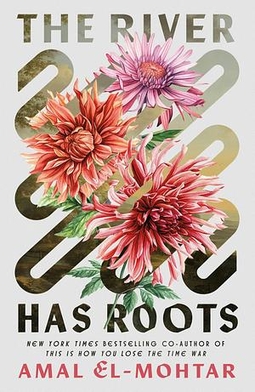
I loved This is How You Lose the Time War when we read it in the now-defunct Austin Feminist Sci Fi book club, so I was pleasantly surprised to see El-Mohtar’s The River Has Roots on the nearly-stripped shelves of SF Bokhandeln’s booth at the Gothenburg Book Fair. It also won a million bajillion awards, including the Aurora Award for Best Novelette/Novella, Hugo Award for Best Novella, Locus Award for Best Novella, and Nebula Award for Best Novella. The friend attending the fair with me offered it as a gift (he’d already picked out two books for himself and it was buy two, get one free) and that’s how I ended up with a copy, confident that my high expectations would be met.
Alas!
The River Has Roots is very much an atmospheric book, almost to the exclusion of everything else. Part of that, then, means my reaction is a simple Not For Me; I’ve hit my limit of twee English folktale Fae when it comes to atmosphere. The plot is a short story stretched out into a novella through (lovely!) illustrations and prose that, if not fully purple, then is at least lavender.
There’s a magical river of grammar that feeds some magical trees that a particular family has a particular job? pact? with: they have to sing to the trees. The sisters in the family, Esther and Ysabel, are more than happy to carry out this work, and we get a lot of overwrought explaining about how close the two of them are and how much they love each other. Esther is being courted by an asshole named Samuel Pollard for practical business reasons, but she’s really in love with a Fae named Rin. Samuel decides, out of the clear blue sky, to murder Esther and court Ysabel instead (there was nothing stopping him from skipping the murder and moving on to Ysabel, but then there wouldn’t be a story so a murder it is), the magical grammar river halfway saves Esther’s life: she’s immortal as long as she stays in Fae lands, but the minute she steps in human territory in her human form, she dies. Rin enchants Esther, turning her into a harp for her trips to human territory, and through the magic of song reveal Samuel as Esther’s murderer. (There’s some implied danger of “well Samuel will maybe also murder Ysabel?” but writing up this summary now I don’t remember the reasoning, it might be safe to assume that there is none.) Esther gets to live happily ever after with her Fae lover, Ysabel escapes an ill-advised (maybe dangerous?) marriage and manages bring herself to visit Fae territory to see her sister.
I’ve mentioned here before that I’m not much of a poetry person, and nothing’s changed since the last time I mentioned that, but there’s something about a book where the narrator dunks on one character for writing bad poetry and praising another for writing amazing poetry but where the poetry seems to be a middling average quality from both that makes me not inclined to be kind to the author.
I expect The River Has Roots swept up at the awards mostly because of the goodwill people still had for 2019’s This Is How You Lose the Time War and that, with the passage of time, a lot of people will be revising their opinion of this one.
