
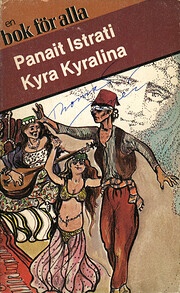
This was an international WhatsApp book club pick because Panait Istrati seems like an interesting guy, and Kyra Kyralina specifically occupies a niche as the first Romanian novel with a gay protagonist and the first novel in Istrati’s Adrian Zografi cycle. A landmark novel in many respects.
Landmarks aren’t necessarily a fun read, however, and it was a struggle to grasp what Istrati was trying to do. It’s a bildungsroman of sorts, but with a rather disjointed chronology and a lack of interiority. Despite the book’s inclusion in the Adrian Zografi cycle, here Adrian is only a side character. Kyra Kyralina is really the story of Stavro, né Dragomir, as told to Adrian on different occasions over the stretch of several years. The first section focuses on Stavro’s most recent past: the story of his unhappy marriage. The second section then goes all the way back to Stavro’s earliest childhood, and the third and final section fills in the gap between that childhood and the unhappy marriage. The first two sections are narrated rather close in time to each other, with only a few days in between. Adrian doesn’t hear the last section until several years later when he happens to meet Stavro in Egypt.
To put it chronologically: Stavro was born in Braila, Romania, and spent his earliest days with his mother and sister, the titular Kyra. They were wealthy largely due to his mother’s inheritance, though his father and older brother ran a very successful wagon business. The latter two eventually move to the other side of the city to be closer to the wagon workshop, but they periodically make visits to the other home. In their absence, Stavro’s mother and Kyra live the good life, dressing up and hosting parties full of dance and music, attended by young suitors. Young Stavro’s job is to keep a lookout for his father and brother, so the suitors have time to escape out a back window. During these visits home, and just about every day before relocating to the other side of the city, Stavro’s father beats his mother.
The turning point comes when Stavro’s mother decides to throw the party to end all parties, perhaps because she can sense that things are about to take a turn for the worse, or perhaps because she has some kind of death wish. Either way, it turns out as she expects and Stavro’s father beats her within an inch of her life, blinding her in one eye. Kyra is locked in a wardrobe and Stavro taken back to the other house by the workshop. He manages to escape and to rescue Kyra and his mother, and they flee Braila.
Stavro is around twelve years old at this point.
Stavro’s mother leaves him and his sister in the care of her brothers while she seeks medical treatment for her eye and disfigurement. That’s the last we see of her, and given her declaration that she was determined to kill herself if she ever lost her beauty or ability to enjoy life, it’s safe to assume that she takes her life at some point off screen.
Kyra, meanwhile, immediately spurs their uncles into avenging the violence enacted on the family, and the uncles agree. Their older brother is killed in the ambush, but their father escapes and Stavro and his sister are sent to a safehouse. It doesn’t take long for them (or for Kyra, at least) to get bored with their new life, and they are soon kidnapped. Their kidnapper sells Kyra to a harem (which is only mentioned in an aside), while Stavro remains with him as, it is heavily implied, a sex slave.
(So ends section two.)
He manages to escape after a few years and immediately sets about Istanbul looking for his mother and his sister, to no avail. It doesn’t take long for another creepy old man to abduct Stavro, luring him in with false promises of helping to find his family only to once again keep him as a sex slave. More years pass and Stavro once again manages to escape, get some papers (this is the point where he becomes Stavro rather than Dragomir), and then get robbed. One day he ends up in Damascus, and sees a cart pass with a woman who looks rather like Kyra. Stavro tries to get her attention, following the cart all the way to a villa. He’s denied entry, of course, and that’s where an elderly salep vendor finds him and takes him in. They spend many happy years together, even after Stavro serves a stint in prison and is exiled from the city, until the older man’s death.
(So ends section three.)
Stavro ends up in Bucharest, a sort of itinerant merchant and maybe still selling salep. He boards with a family for a while and becomes infatuated with their daughter, telling her stories of his travels. This escalates until they are engaged to be married, but tradition dictates that newlyweds are obligated to prove that the marriage has been consummated (by means of some bloodied sheets). Stavro cracks under the pressure to perform, and under the pressure of his own presumed homosexuality, and promptly faints and then falls ill. His wife is understanding and compassionate about it, and the community at first see him as an invalid, potentially the subject of a curse. But days, weeks, months go by without any sex, and their patience runs thin. Stavro is once again a prisoner of sorts. Neither he nor his wife are permitted to leave the house, and Stavro in particular has become persona non grata in their quarter of Bucharest. The couple makes plans to leave the city, since they’re still otherwise happy and fond of each other and can imagine a life together. Then, mere days before their escape, his brothers in law find an old traveling companion of Stavros, presumably also a lover, who immediately outs Stavro. (Every translation in the WhatsApp book club seemed to use an interrupted slur for a gay man in this reveal. In Swedish it was rendered as “b—”, presumably short for “bög.”) The escape plans come to nothing, Stavro is driven out of the house, and his bride drowns herself in the river.
(So ends section one.)
The framing device is Stavro’s invitation to Adrian to come help him and another man, Mikhail (I think) sell watered-down citric acid as lemonade in another distant town. Adrian has encountered Stavro somewhere out in town, and we get our first impression of the man: a tragic figure, a bit of a buffoon but intentionally so, someone who is hiding something. His scheme requires some kind of go-between and he thinks Adrian is right for the job. On their first night on the road, the three men spend the night in a hayloft and Stavro makes an attempt to seduce, or at least fondle, Adrian. Adrian is a bit naive, while the worldly Mikhail knows immediately what Stavro is trying to do and berates him for it. By way of apology, Stavro then begins his tale of woe, as if to explain why he has become such a creature so burdened with vice. (“Vice” is the specific word used in the Swedish translation, at least, and is used again and again by Stavro to describe himself and by others to describe him.)
Stavro is a tragic figure. Any joy, any pleasure, any human connection he’s ever had is almost immediately tainted with tragedy. That much is clear. But it’s hard to situate Stavro in a narrative. We don’t see a progression from naive to embittered, or ignorant to more worldly. The inside-out chronology means that the book ends in the middle of Stavro’s life, a very deliberate narrative choice that immediately invites speculation. Why does this episode have such an ultimate ring of finality to it?
Putting aside the larger question of the disjointed timeline, it’s hard to like Stavro. It’s hard to like any of the people we’re supposed to feel sorry for. Yes, Stavro’s father is a petty, violent tyrant, but his mother and sister come across as party girls with no interest in taking care of themselves. Of course I’m reading Kyra Kyralina through a different lens than the original audience, in a different social context, but the way that Stavro’s mother insists that she is a creature made to enjoy luxury, love, pleasure, and that she cannot be other than what she is hits a sour note for me. I managed to find an English translation of exactly the passage I’m thinking of:
I was made by the Lord for the pleasures of the flesh, just as he made the mole to live underground without light. And just as that creature has everything it needs to live in the earth, I was lacking nothing to enjoy my life of pleasure. I made a vow to kill myself if I were forced by men to knuckle under and live a life other than what my body and soul dictated. Today, I am thinking about that vow.
From the blog seraillon, who seemed to like Kyra Kyralina a lot more than I did.
Other places describe the story as a picaresque, but it’s hard to read consistently getting kidnapped and imprisoned by different abusers as a picaresque, since much of the time Stavro is confined and not meeting that many people or having that many adventures. Stavro himself isn’t particularly interesting, either. Things happen to him, but we only get surface level emotions in response.
There is also a question of version and translation: Istrati wrote the original in French, but then rewrote it and completely reworked it in Romanian. The Swedish translation, judging by the translator (Barbro Andersson), was from the Romanian version rather than the French. One wonders how much was different between the two versions.
